[Note: There are problems at the moment with Airliners.net, and as a result, many of the photo links might be down. We will continue to monitor events and introduce a 'Plan B' if need be.]
Part 1
| Back
in 1993, during the course of a wide-ranging interview, I gave a
response to the journalist's question which has become somewhat legion.
When asked about the state of aviation development, I replied that
"...the best aircraft which will ever be designed in the industry have
already been built." Surprised, the journalist-- rather flustered--
wondered if I could give an example of such an 'immortal' design? "I'll
name three: The DC-3, the Po-2 and the B-52". Ironically, the dissolution of the USSR was the death knell of the wonderful old Po-2, and within months of that reply virtually none would remain in operation. And, more than thirty years on, perhaps I would now add to that list such machines as the Tu-95 and the Piper Cub... and, of course, the impossible Antonov An-2. The Improbable, Unstoppable and Indominatable An-2... |
They Could Go On Forever
The epithet "improbable" seems a bit understated for the accomplishments of the dear old An-2. That a biplane design was still in licensed, serial production in the year 2000 virtually defies any description. Moreover, the enormous list of superlatives attributable to it seems like a work of fiction, and add to that a design still hard at work around the world in the many hundreds, if not thousands. But, even bearing in mind all of these things, one superlative will never bet bettered, in that the An-2 is the last biplane still in regular military service-- with an engine designed in 1938-- and in more than a handful of countries! In an age of "6th Gen" stealth fighters and AI drones, how can one even write such a thing?... Truth stranger than fiction.
It is true that the Russian Federation and the VKS have decided to retire the An-2 "as soon as practicably possible". The LMS-901 has been designated as the preferred replacement, but this machine is both late and, it must be pointed out, not particularly better than the An-2 in terms of loading nor capacity. Further, no design built in 2026 will equal the Antonov's indestructible reliability nor safety record. Indeed, one comes away with the impression that the driving force behind this decision is the fact that the Federation no longer distils high-octane aviation fuel, which must therefore be imported. Antonov have already developed turbo-prop driven models of the An-2/-3, some of which have been in civilian service for 20 years, and the VKS does have a back-up plan to so convert existing low-hours airframes should the LMS-901 be delayed further. If such a conversion process comes to pass, one could well image that An-2s with turbine engines might remain in service... well... indefinitely.
Liveries of the Entire Aviation World
The purpose of this series of articles is not to recount the development and operational history of the Antonov An-2 family. That job has been done very, very well elsewhere, and the author sees no point in summarising this work again. Free resources of superb accuracy are even available, and the author suggests this URL as a great primary read:
 http://www.airwar.ru/enc/craft/an2.html
On the contrary, we look to focus here on the frankly astonishing breadth of colour schemes and markings seen on the An-2, both civil and military, both historical and contemporary. Information-- as much as is known-- will be provided on each example below each profile. Feel free to admire, and quite likely, to be amazed...
"Black 822", LSK der DDR, ca. 1954
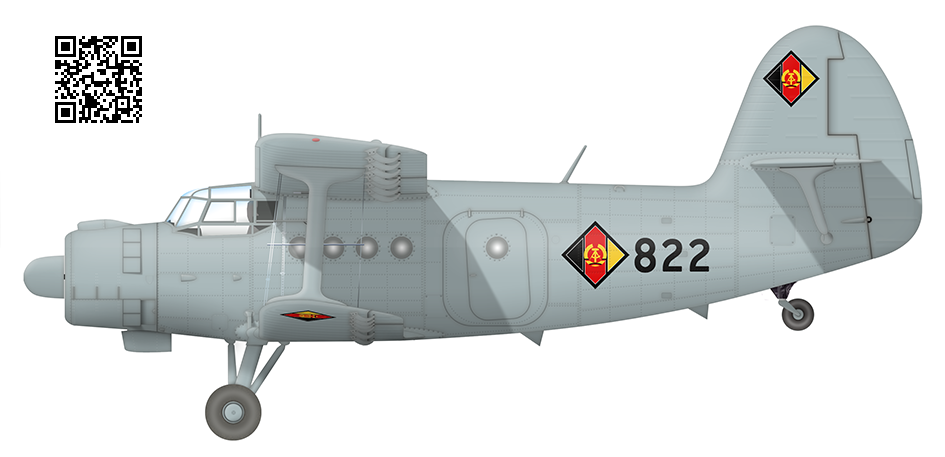
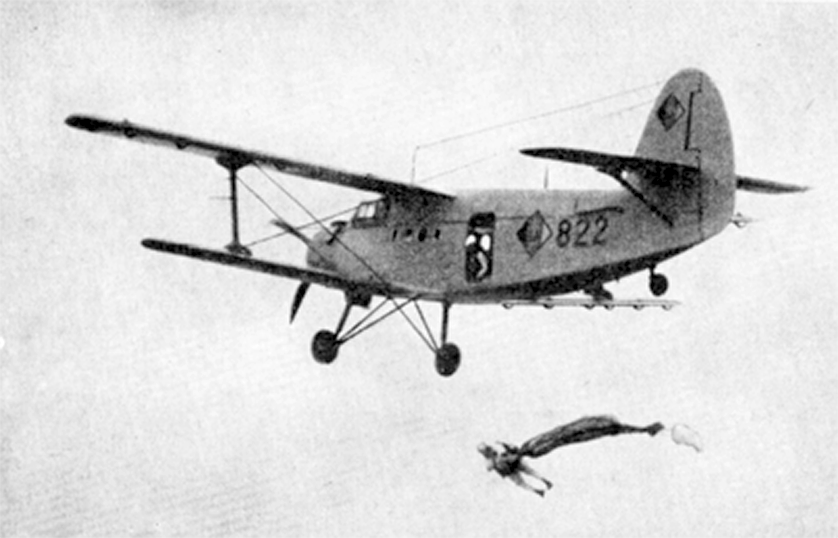
"822" was an original Antonov built An-2T model, complete with a radio altimeter and spinner. The finish was an over-all coat of AMT/AGT-16 Grey (the gloss level cannot be determined in the poor image; see above), and the usual LSK markings were seen in eight positions. This machine was photographed both with and without (as here) specialised para-dropping kit, which consisted of a railing mounted to the starboard fuselage and deleted passenger door.
RF-00180, DOSAAF, Russian Federation, 2025
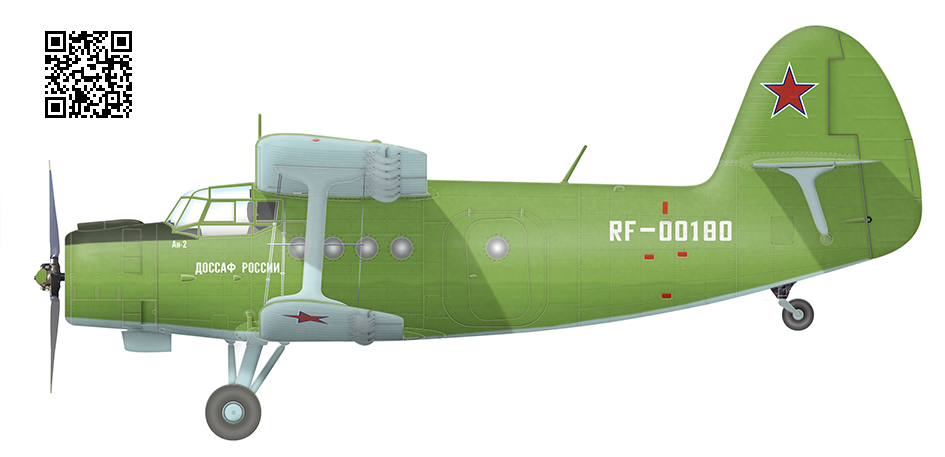
This handsome An-2 is still in active service with DOSAAF, Russian registry RF-00180. This is a PZL built example, likely completed in fact as an An-2R when manufactured. As with so many of these agricultural models, 00180 has long since lost its spraying apparatus and other components. The scheme harkens back-- likely deliberately-- to the early An-2 era's appearance of ubiquitous green-over-blue, here using 1970s lacquers S-38 Lt. Green ('Dacha Green') and Lt. Blue, the finish being fairly gloss. VKS markings are seen in six positions.
 Click [Left] for a web-based photograph of this example.
An-2R SP-FLZ, Poland, ca. 2003
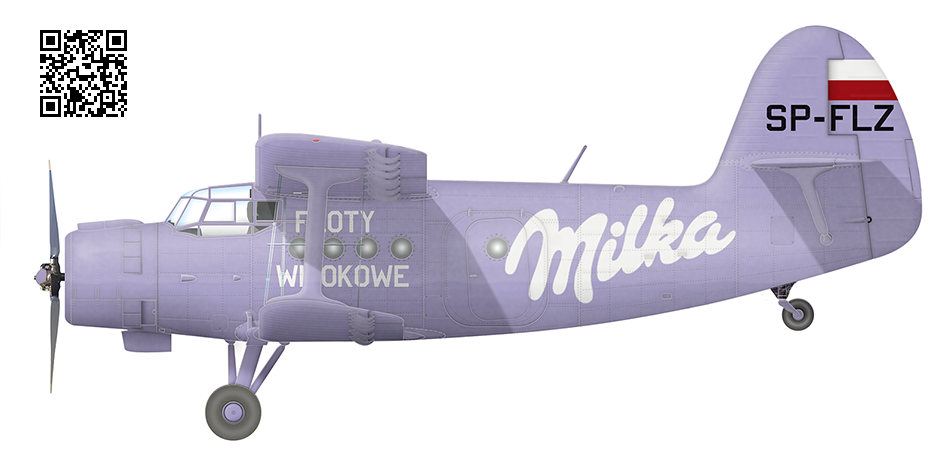
One of the author's favourites, SP-FLZ was one of at least two Antonovs flying in Milka's distinctive livery during the 2000s. The author does not know why this machine was seen in a Polish hangar, and wearing a Polish dedication inscription, rather than being based in Switzerland. Be that as it may, the finish was certainly gloss, and an image is known of this aircraft with yellow painted wings (as completed at the PZL factory). Indeed, SP-FLZ was a PZL built An-2R example originally, quite probably manufactured in the late 1990s.
Click [Left] for a web-based photograph of this example.An-2R OK-DAC, Hosin, Czech Republic, 2019
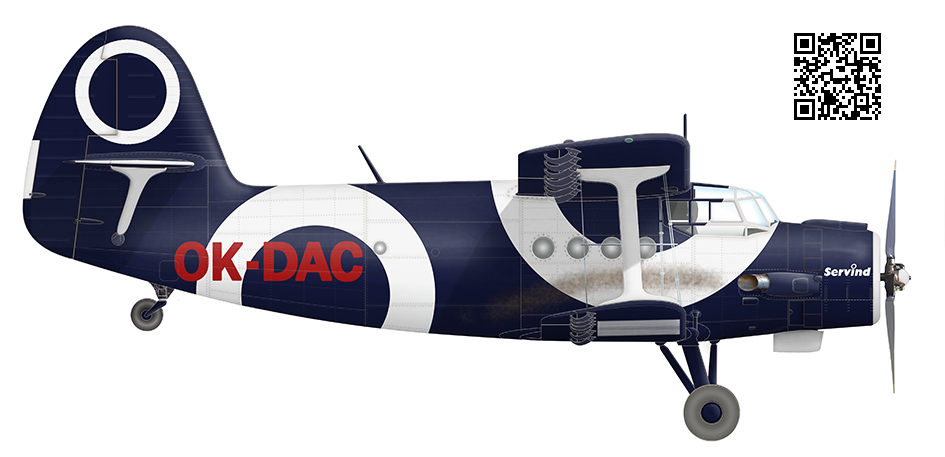
According to the photographer, this exceedingly smart (PZL) Antonov was originally HA-MDF, and subsequently OM-ACO. In the later 2010s, the automotive finishes company Servind acquired this machine and re-painted it in this wonderful livery in keeping with their corporate theme. Certainly, this aircraft would have done their trade no harm by any means, showcasing both skill and style in the painting realm. The finish was semi-gloss, and it was clearly actively flying-- as seen by the considerable exhaust staining-- at the time of the image.
Click [Left] for a web-based photograph of this example.An-2P SSSR-23879, Borki, Russian Federation, 2024
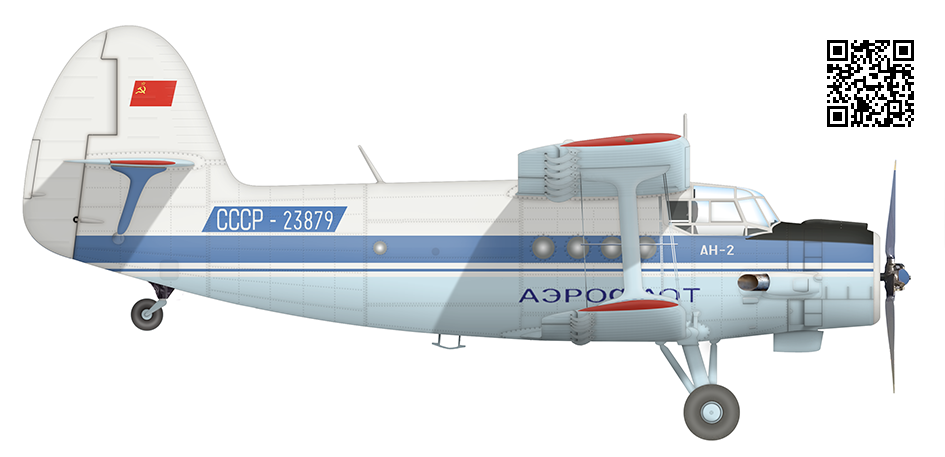
When this classic Aeroflot example
was photographed in 2024, it did not, admittedly, appear to be in
current operation. However, the livery is utterly prototypical, a
superb specimen of the many hundreds of Antonovs in Aeroflot service
during the latter half of the 20th century. When new, the original
finish was usually something between satin and semi-gloss, and they
were customarily kept in pretty smart trim (washed off exhaust, soot,
grime) as above. The "P" models were built specifically for passenger transport (P = Passazhirskii), and included such refinements as seat cushions, sound-proofing and even a small portable toilet in the aft cabin! Luxury...
Click [Left] for a web-based photograph of this example.
An-2TD SP-EGB, Miroslawice, Poland, 2005
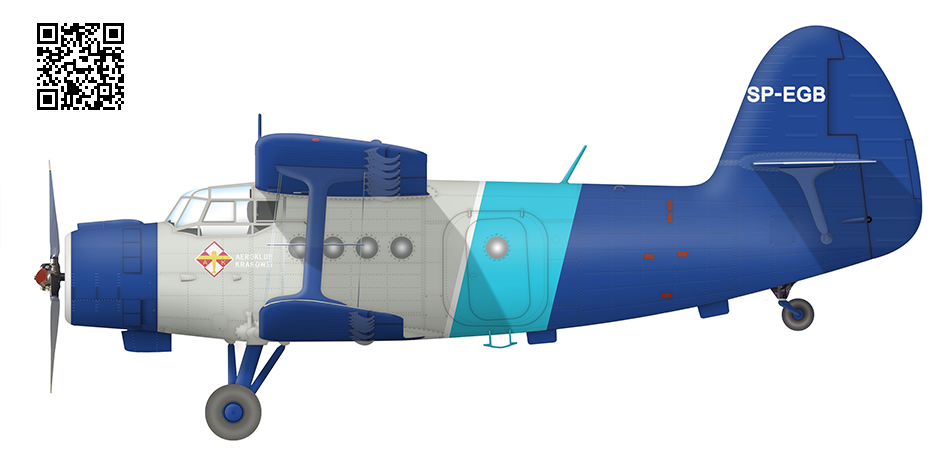
Another wonderfully painted An-2 is this beauty, SP-EGB. As seen in 2005, the aircraft was in service with the Aeroklub Krakowski, which is the subject of the badge and inscription below the cockpit. The original finish was likely semi-gloss in sheen, but photographs exist showing this machine a decade later-- still flying-- but a bit more worn and dull in appearance. In the author's eyes, it would be hard to find a more appealing colour combination.
Click [Left] for a web-based photograph of this example.
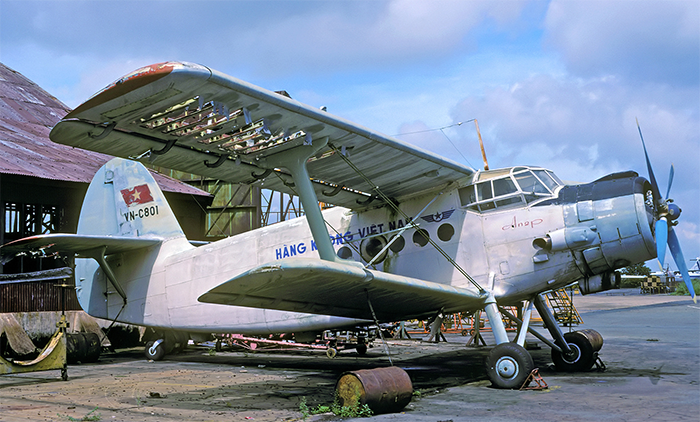
An-2R VN-C801, Viet Nam, 1989
Click [Left] for a web-based photograph of this example.An-2TD SP-EGB, Miroslawice, Poland, 2005
Another wonderfully painted An-2 is this beauty, SP-EGB. As seen in 2005, the aircraft was in service with the Aeroklub Krakowski, which is the subject of the badge and inscription below the cockpit. The original finish was likely semi-gloss in sheen, but photographs exist showing this machine a decade later-- still flying-- but a bit more worn and dull in appearance. In the author's eyes, it would be hard to find a more appealing colour combination.
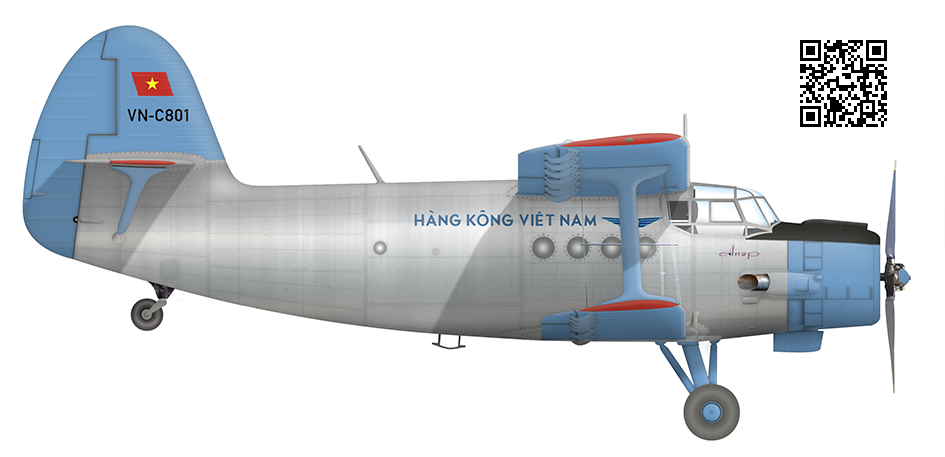
Click [Left] for a web-based photograph of this example.An-2R VN-C801, Viet Nam, 1989
This neat An-2R was built in
Moscow, and was originally seen in a grainy 1989 image from a period
magazine. Below, the same machine is seen years later, but indeed still
intact and certainly recognisable. Who knows how long this aircraft
flew passengers for the airline which would eventually become Vietnam
Airlines? It still looks to be in reasonable condition, and we can only
hope that perhaps someone might have the idea to restore it to its
former glory.
--------------------------