Soviet aviation design during the 1930's showed a
wonderful, expansive type of innovation which at times, it must be
said, bordered on naivety. Such was the case with the contemporary
fixation on recoilless rifle armed fighters in the USSR during that
decade. At the same time that Western European aviation designers were
obsessed with turret armed fighters, Soviet bureaux-- hoping to address
the same problem of increased lethality against medium bombers--
devolved the "rocket-gun" approach to the matter. It was thought, as
the theory went, that small fighters armed with two powerful recoilless
rifle weapons would be able to approach the enemy and dispatch it from
close range with one fatal salvo. The newly designed APK-4 recoiless
gun was seen to be the ideal choice for this purpose, and a number of
contemporary designers seized upon this weapon for use in their
prototypes.
The APK-4 (Avtomaticheskaya Pushka Kurchevskogo)
was a 76.2 mm weapon of the so-called DRP (basically,
recoilless-reaction type) class designed by LV Kurchevskij. The gun was
designed to mitigate the normal recoil forces of firing the weapon by
means of simultaneously detonating a secondary charge in the opposite
direction to the projectile. When, indeed, the secondary charge was
fired simultaneously to the main round the theory was valid enough, but
considerable difficulty arose in ensuring such strict timing with
regards to the firing sequence. After much development and struggle,
the concept was eventually overtaken by more usual aviation cannon, and
abandoned.

APK-4 recoilless rifle
The Central Design Bureau (TsKAB) at Zavod 39
in Moscow naturally sought to develop such an important fighter of
their own. During the summer of 1930, a team led by Chief Designer
Grigorovich was put in hand to undertake such a study, and build a
prototype. However, so advanced was the concept of the 'rocket-gun
fighter' seen to be that the Government declared the entire project to
be secret, and development of the TsKB-7 prototype was masked with the
code name "Z". Such was the curiosity of Soviet practices of the 1930s
to name the project with a letter which does not exist in the Cyrillic
alphabet nor in the Russian language! As a result, the foreign letter
was typically pronounced phonetically ("zet"), and the terms "I-Z" and
"I-Zet" should be seen to be interchangable.
Development of the "Z" fighter progressed well, and the initial
prototype TsKB-7 was completed on 5 June 1931. This aircraft-- in which
Stalin was famously photographed at the controls in the cockpit a month
later-- featured individual streamlined cylinder head covers for the
M-22 engine along with a large propeller spinner, and the APK-4 guns
were mounted inboard the large landing gear struts. A 7.62 mm PV-1
machine-gun was mounted to starboard above the engine synchronised to
fire through the propeller. Flight testing of the TsKB-7 commenced in
the late summer and autumn of the same year, but the handling
characteristics of the machine were found to be quite unsatisfactory.
As a result, the design team at Zavod 39
began a comprehensive review of the prototype, this work culminating in
several improved examples during late 1932. The new prototypes all
featured a Townend ring for the engine, discarding the spinner as well.
The cockpit opening was revised, and many aerodynamic detail
modifications were incorporated into the new examples. During February
and March 1933, the I-Z prototype p/n 39009 was examined by the NII VVS
at Schelkovo. Due to the winter conditions the aircraft mounted ski
type landing gear. Handling in the new prototype was found to be
greatly improved, but the aircraft still demonstrated rather unhappy
spinning characteristics, and on these grounds the NII VVS refused to
pass the aircraft on its State examinations.
Nevertheless, 22 I-Z fighters were eventually completed at Zavod 39. Production of the type was then relocated to Zavod 135
at Khar'kov, where some 80 more examples were delivered between
1934-35. During the summer of 1935 the I-Z was at last officially
accepted by the NII VVS, but only with the revised armament scheme
incorporating two 37 mm APK-11 guns instead of the APK-4. These were to
have been installed by the regiments operating the I-Z (since
production of the type was already complete, none were delivered in
this configuration), but very few photographs exist showing such
armament on the aircraft, and it would seem that virtually all of these
fighters persisted with the APK-4. A few I-Z fighters carried on in
service into 1936, when these were comprehensively replaced by the I-16.

The TsKB-7 no.1 prototype as completed in June/July 1931, finished in some kind of aluminium dope (exact type unknown)

I-Z p/n 39010 under investigation by the NII VVS at Schelkovo, 1933.
This aircraft featured the outer placement of the APK-4 gun, as seen on
the usual production examples (p/n 39009 seems to have been the last
with the inboard arrangement). As with virtually all aircraft produced
at
Zavod 39, the finish in view looks to have been AEh-15 upper surfaces, and likely AEh-4 below.
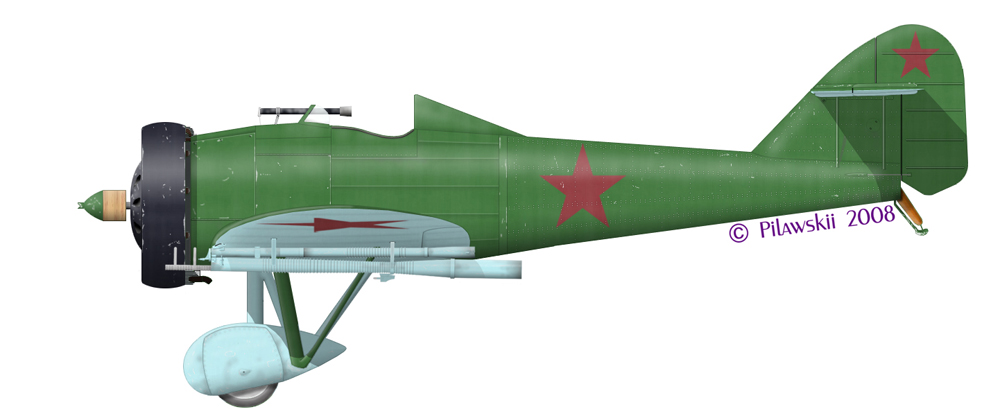
Series manufacture I-Z from Zavod 135,
p/n 213518, under investigation by the NII VVS during March 1935.
Examples from Khar'kov usually appear to be lighter in appearance than
those from Moscow, and the most likely finish with that observation in
mind would have been lacquer 3B
(with AEh-4 unders again). The cowl could have been darker in the
image, suggesting AEh-11 colouration (a common option on AEh-4 schemes).
