| Rockets,
Bombs and Other Ordnance of the VVS in the GPW |
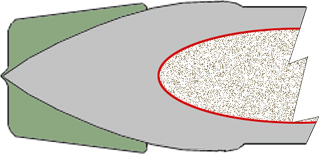
Part III The BETAB Rocket-bomb The 'Other RS' During the 1930s, Soviet munitions designers were well advanced in several areas of conceptual development. Amongst the most intriguing of these was the concept of the rocket assisted bomb. Indeed, this work was carried on in conjunction with the more commonly known RS rocket, to which they were seen as an alternative and complimentary munition [and with which they are routinely confused]. The development of the BETAB and BRAB series rocket bombs was a highly complex matter, and we will only touch upon the highlights of this story here. In 1936, the Navy (VMF) asked one of the NII's many departments, No.3, to undertake a study of superior armour-penetrating munitions for use in anti-maritime aviation duties. These studies coincided with the development of the RS rocket, and the department investigated versions of the RS 132 missile for these purposes. There were many, many theoretical plans in this regard (which by themselves could make for an entire book on the subject), and by 1938 these had merged with an intention to develop a 203 mm version of the RS. In the end, a 203 mm version of the RS was seen to be impractical, however this size of munition was developed further by the NII-3 in line with a new concept-- the rocket assisted bomb. Moreover, the NII-3 had developed a new explosive type for this kind of weapon, this named TM-4(b). The concept of these munitions was straightforward, if novel. The rocket motor was designed firstly to imbue the bomb, which was to be released in the traditional manner (i.e. in level flight, or from a shallow dive if required), with a more stable trajectory after release. Secondly, the rocket motor would add to the kinetic energy of the bomb upon impact, thus aiding its penetrative powers. In fact, both concepts proved to be quite valid, but particularly so the latter. The thrust of the rocket motor added enormously to the penetration of the munition, as seen in the following NII-3 test results using the prototype 203 mm BETAB: Bombs dropped from 2000 m against face-hardened concrete
This outstanding penetration capability, married to improved accuracy through a more stable trajectory, immediately caught the eye of the VMF. The Navy recognized this kind of munition as an anti-shipping weapon of exactly the type that they had requested in 1936. Thus, from 1938 onward, the VMF became inexorably intertwined in the development of these bombs. Development was rapid, and testing was conducted at a vigorous pace, reflecting the service's keen interest in this new munition. Indeed, by 1939 the Navy had used its various connections to instigate production of these weapons at Zavod 80 (NKB) under the designation BETAB-150DS. The acronym 'BETAB' I do not currently understand fully, but the number cipher was obtained from the weight of the munition, and suffix 'DS' stood for s dopolnitel'nimi skorostyami, or 'with supplimental velocity'. Navy BRABs At the same time investigations were underway concerning the future BETAB munition, the VMF was also interested in the development of a new series of special purpose armour-piercing bombs. This new family of bombs were intended specifically to penetrate the steel armour plate of warships, and other related targets, and they acquired the designation BRAB (broneboynie aviabombi, or 'armour-penetrating aviation bombs') from the outset. All manner of possible BRAB configurations were considered and tested. In 1938, a 150 kg version with similar dimensions to the new BETAB appeared, and this munition was seized upon immediately in the new enthusiasm regarding rocket-bomb types. Thus, the NII-3 built and tested several DS type 203 mm BRABs, these featuring the same rocket aft section as the similar BETAB. Bigger is Bureaucratic As these programmes continued, Navy enthusiasm for rocket-bombs reached astronomical proportions. BETAB and DS powered BRABs of increasingly larger weight and calibre were continuously built and proposed. Further, so engulfed did the VMF become in this development work, that the primary Department of the NII in Leningrad, No.24, also was drawn fully into these efforts by sheer proximity to the Navy's headquarters in that city. Indeed, the NII-24 worked on munitions of 254 mm diameter-- resulting in the BRAB-500DS-- followed by even larger rocket-bombs of 305 mm size (such as the BETAB-750DS). In fact, bigger bombs that these were actually built (the BRAB-800DS prototypes, for example) by NII-24, but some of their proposals from 1940 read like pure fiction; one BETAB was suggested at a staggering 3000 kg weight!! However, such proposals were mere bureaucratic fancy. Any engineer can attest that weight, thrust, and energy calculations do not scale proportionally, and the larger the munitions became, the less became their value as compared to more traditional AP bombs. Sanity managed to prevail, and none of these colossal blunderbusses were ever constructed.... ------------------------------- Disregarding the many small series of experimental types-- some of which, admittedly, were in fact employed operationally during the War, the following can be seen as the main series of BETAB and DS BRAB munitions of the era. BETAB-150DS 1940
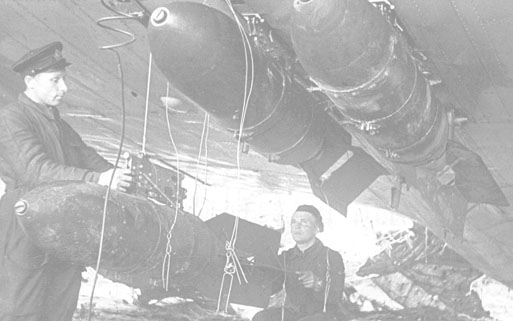
The original 203 mm calibre rocket bomb munition was this weapon, the -150DS. The rear rocket motor housing was built separately, and was standard for all of the munitions of 203 mm size. The fins were welded to the housing, and were somewhat thick sheet metal, as was the rocket casing itself. The forward portion of the bomb comprised the warhead, this a 17 kg charge of TM-4(b) explosive surrounded by a thick, hardened alloy steel sheath of ballistic shape. The model depicted here is typical of manufacture from 1940, finished in the ubiquitous medium blue Soviet industrial paint, and the standard aviation bomb lacquer No.67 was usually applied to the munition before delivery. The aft mounting strap was similar to that of a small FAB, whilst the forward mounting strap featured an electrical receptor socket at the tip. After release, a wire from the aircraft would detach from this point and the rocket motor would fire after a small delay. Rocket bombs were only carried externally, it being thought that internal storage was vastly too dangerous (albeit, technically feasible on aircraft like the Il-4 and Pe-2). The BETAB-150DS was utilized throughout the VMF, on all fronts, and was seen well into 1943.
BETAB-170DS 1942
Manufacture of the BETAB-150DS model gave way gradually to the -170DS during 1942. The new model was slightly shorter than the -150DS, and carried less explosive filling in a warhead of thicker nickel-alloy steel. The aft rocket housing was indentical, as previously mentioned. The model depicted here is typical of manufacture from 1942-43, and is finished in Industrial Metal Primer, which was very widely use for rocket bomb production. The BETAB-170DS remained in use with the VMF for many years after the GPW, and was regarded as a very effective weapon. In fact, so well regarded were BETAB-170s, that some Army regiments also made limited use of them, presuambly having obtained them from nearby VMF units. Moreover, authors Reznichenko and Pir'ev mention in their official VVS bomb history that a variant of this munition remained in production and in the Soviet aviation inventory, essentially unchanged, into the 1970s-- a pretty fair claim to sucess, indeed.
BRAB-200DS 1940
Alongside the BETAB, the Navy also developed a rocket version of the BRAB armour-piercing bomb. This munition was also of 203 mm calibre, and utilized the same rocket motor and housing as the BETABs of the same size. The warhead, however, was indeed that of a BRAB bomb, featuring a very sharply pointed AB-1(d) nickel-steel alloy casing. A small protective cap, of light metal construction, was applied to the tip (presumably to protect it and the armourers). The bomb is shown here in ALG-1 finish, as suggested by Reznichenko and Pir'ev. Limited manufacture of the BRAB-200DS was undertaken prior to the GPW at Zavod 78 (NKTM). Something like 3000 of these bombs were completed by 1941, but production was terminated in favour of the BETAB series, and the focus for the BRAB munition was thereafter on non-powered bombs of larger calibre. Despite this fact, all of these weapons were used operationally, until supplies were exhausted (perhaps during 1942?), and they were noted for excellent armour penetration capabilities.
BRAB-500DS 1939
The NII Department No.24 became heavily involved in the development of larger and larger rocket-bombs. The basic design of the rocket housing for these was unchanged, but the diameter in this case was increaed to 254 mm, and consdierably lengthened (for additional propellant). The warhead was similar to that of the smaller -200DS, but proprtionally larger (i.e. 254 mm diameter). I have only a single photograph showing this type, and it appears to have been completely unpainted; thus, the appearance here. Limited manufacture of the BRAB-500DS was undertaken during
1940-41. The munition had seemed to be impressive, but testing at the TTT
revealed that it was not particularly accurate, and plans to produce this
bomb in large numbers were abandoned. Something like 500 examples were
built in all, of which 136 examples were delivered to the Army (including
the LVO and KOVO). Their subsequent employment during the GPW is not clear
at this time.
BETAB-750DS 1941
If the BRAB-500DS seemed a bit over-sized, the BETAB-750DS was a colossus. The sheer impracticality of employing a four meter long bomb munition would seem to have been obvious to anyone, but apparently this was not the case at the NII-24. Constructed as the previous rocket bomb types, the diameter of this weapon was 305 mm, both the rocket housing and the warhead. It is shown here in IMP finish. Only a small number of -750DS bombs were built, these mostly of an experimental nature, and during 1940-41 eighty were completed. Following the failure of the BRAB-500DS at the TTT, all plans to pursue this weapon seem to have come to an end. However, despite this premature termination, all of the BETAB-750DS munitions were delivered to the Baltic Fleet (KBF) during 1941. The KBF, remarkably, retained and subsequently utilized these weapons during the War, and indeed more than once with notable success. The -750DS could only be carried by the Il-4, two at a time. On the other hand, the impact of this mighty AP bomb must have been tremendous, and several of the stubborn concrete bunker emplacements in the Gulf of Finland were apparently destroyed by these weapons. |