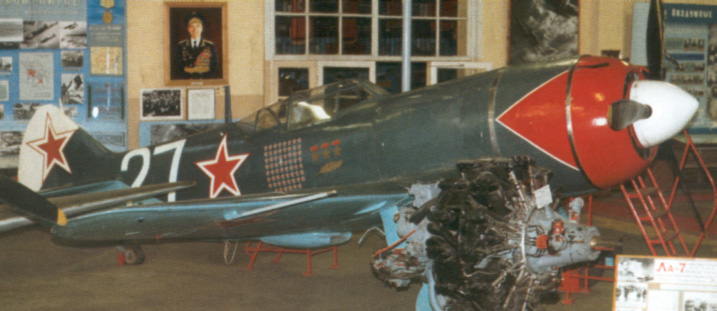
| Lost in Time... The Misadventures of Ivan Kozhedub's Famous La-7 "White 27" |
| Lost in Time... The Misadventures of Ivan Kozhedub's Famous La-7 "White 27" |
| NB: This article was completed in 2004. Any subsequent modification to, or re-painting of, the Monino La-7 exhibit (or to the Monino Museum itself) since that time will therefore not be addressed in this document. |
| Perhaps no pilot
is more recognizable in Western
literature than the VVS GPW ace Ivan N. Kozhedub. And, of course,
equally
celebrated is Kozhedub's famous La-7 fighter, "White 27".
This aircraft
has been the subject of countless artwork, colour profiles, drawings
and
other renditions over the last 60 years in Western literature, and
seemingly,
never in the same way twice! The development of the perception of
"White
27" is a neat caricature of the general gross misinterpretation of the
VVS, as such, over the last 60+ years. What is the truth behind "White
27"? What do we really know about this famous fighter?
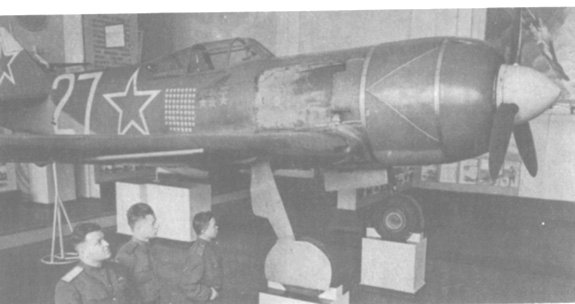
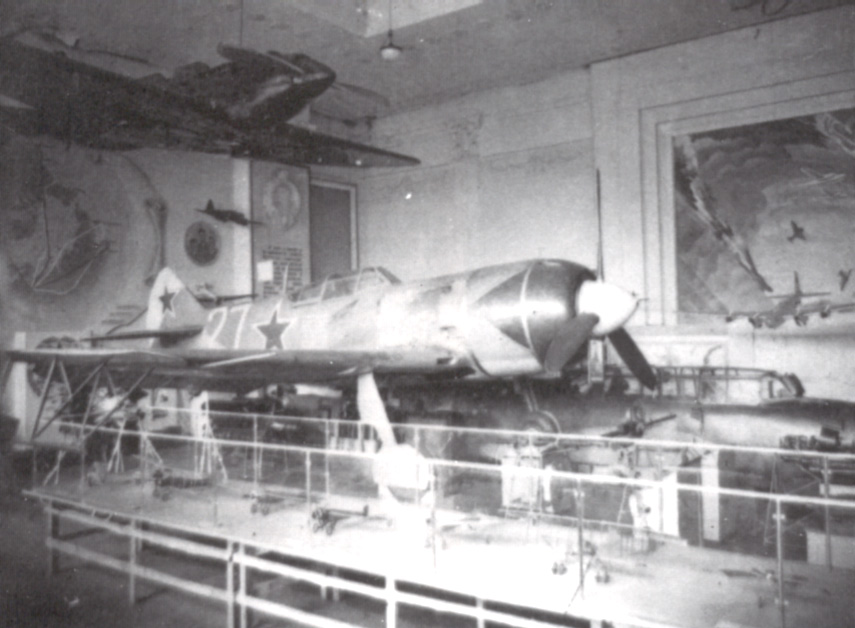
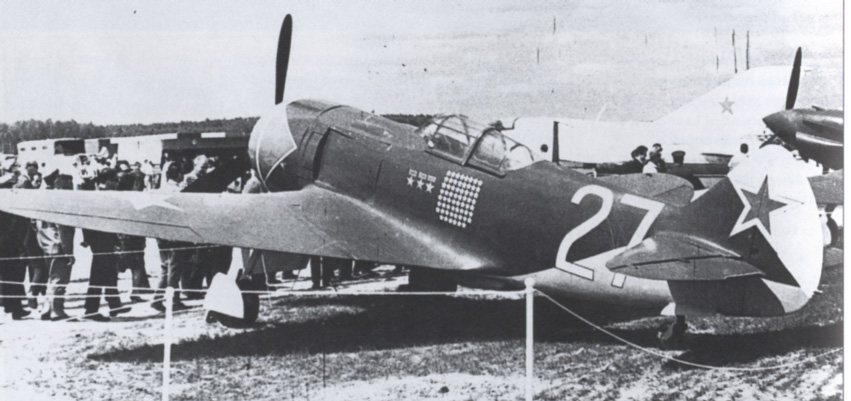
Cold War and Cold Brains During the years of the Cold War, a number of photographs circulated of "White 27" in the West. The most common was probably this photograph showing "White 27". This photograph shows the aircraft on display in the main hall of the Tsentralniy Dom Aviatsiya i Kosmonavtika (TsDAK), Moscow. As yet, no date has been established for the picture.
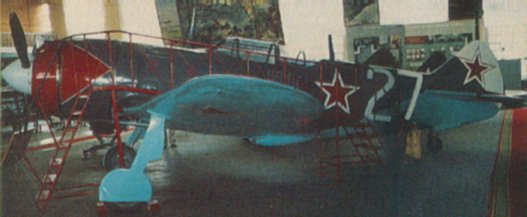
As well, the actual aircraft itself was on public display in the USSR at the Air Force Museum (Monino), near Moscow. The physical appearance of the aircraft in the collection (after 1972) looked then just as it does now.
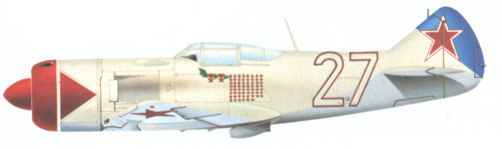
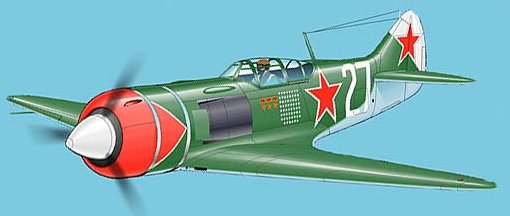
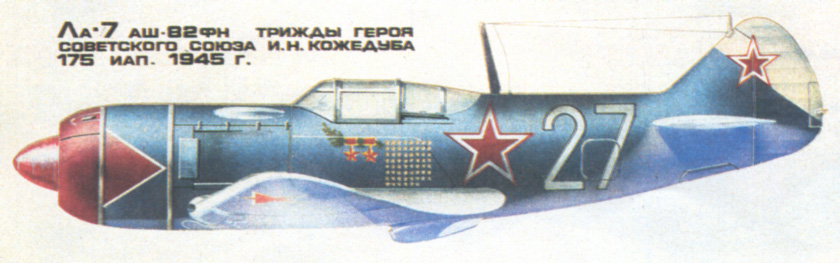
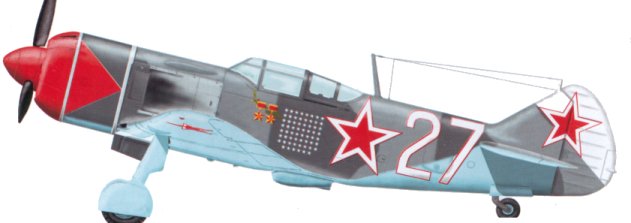
However, from this relatively nice and useful evidence--a physical specimen to examine and a clearly developed (if tonally confusing) B/W photograph--many Western artists derived this colour profile artwork.
This same appearance was repeated time and again, from Facts On File to Air Enthusiast, to the various Pilot Press books, and to serious aviation art. One surely must be at a loss to explain how on earth these various artists managed to derive this colouration from the above photograph (or the actual example)?
Alternately, but with an equal lack of understanding, one would see the stereotypical Russian "green" appearance.
Evidently, every Soviet aircraft manufactured between 1925 and 1955 was either "white" or "green"... (or, of course, RAF Dark Earth and Dark Green colour). Scholarship on this topic was flagrantly absent. Meanwhile, ideas about "White 27" in Eastern Europe were pretty uniform. In these cases, the artist was usually happy to recreate the exhibit as it stood at Monino, but with suitable 'modifications' for its service life in 1945. These would include reducing the HSU badges to two, and often to depict the spinner in red.
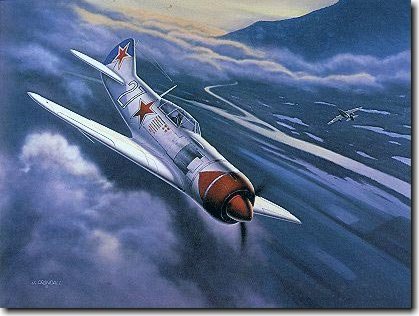
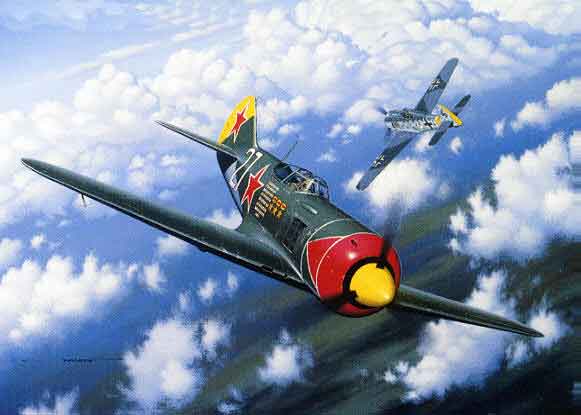
This profile dates from the mid-1970s and comes from Krilya Pobedi magazine (via the GMA book Samolet Stalinskikh Sokolov). It is a rendition of the Monino example, as can be seen, but here also we learn new and amazing "facts" (for example, that Kozhedub was in the '175 IAP'-- not even a Guard's unit!!). Stereotypical misconceptions and errors were (and are) by no means a Western monopoly. Other examples of various interpretations exist, as well. Stan Stokes, another fine aviation artist, offered this painting of "27". Here the artist has apparently been informed by eyewitnesses of the current colour of "White 27" at Monino. The painting is sufficiently close to AMT-12 to warrant favourable mention, but the various details are typical of those from Western literature (e.g. incorrect).
In modern literature we often find "White 27" depicted in a two-colour camouflage scheme as per the alleged details of the May 1945 photograph. An attempt has been made in most cases to show AMT-11/-12/-7 colouration.
These views, whatever their merit, must be said to be vastly improved
over the previous... well... rubbish, actually.
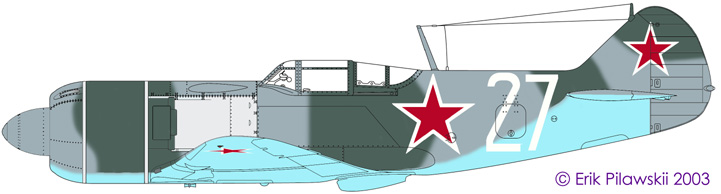
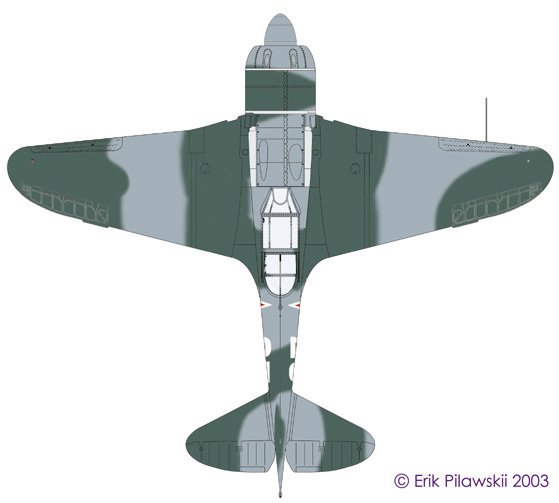
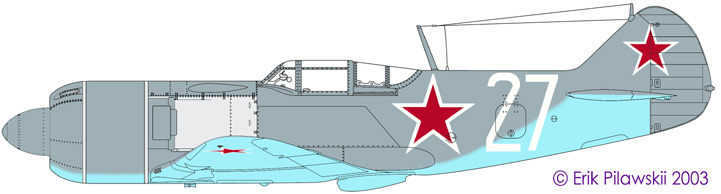
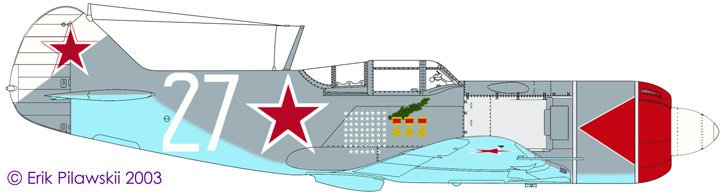
"White 27" At War A most fundamental question presents itself to any researcher when attempting to ascertain the appearance of this aircraft during its service life-- did Kozhedub have only one La-7? The answer to this most basic matter, alas, is actually not known. When Kozhedub arrived at the 176 GIAP as the Deputy Commander of the Regiment, he was then assigned an La-7 aircraft which he piloted during the successful combats of September 22 and 25. Following these victories, a period of inactivity set in. Kozhedub, along with the better part of two eskadrilya from the 176 GIAP, were dispatched farther to the north by Marshal Novikov to counter a group of enemy 'aces' (the German aces Rudorffer, Nowotney, and Phillip are usually mentioned, but I have no idea if this is correct). Before any air combat activity took place, however, the entire 176 GIAP was thusly relocated, and the northern flank of the 1st Belorussian Front became the Regiment's new operational area. Kozhedub's next known victory occurred on 16 January 1945 in this operational zone. So, what happened during these three months of inactivity? In the history of the La-7, a lot, as a matter of fact. A number of flight accidents beset the La-7 at just this time. Repairs and revisions were called for, and all service machines were grounded pending an investigation of the wing structure. Undoubtedly, the 176 GIAP's machines were also examined during this time. This episode may have been critical so far as the appearance of "White 27" was concerned. IF it is true that "27" was the only La-7 mount of Ivan Kozhedub, then we must speculate that the aircraft was built during the spring/summer of 1944. In this case, it almost beyond doubt that the machine would have been finished at the factory (either Gor'ki or at Moscow) in an 'NKAP Template' type of scheme. The precise lines of the application cannot be known, because there is no existing photograph of the aircraft, but it would have looked something like this after delivery to the Regiment.
The tactical numeral was likely applied at the factory (the style here suggests Zavod 381, but this is very inconclusive), and in the typical untrimmed manner. The national markings were probably of the white-bordered type, as was most common during the first half of 1944 ('Victory' type stars were certainly known by this time, and were applied also at the various factories by 1944; but the photographic record shows that until autumn 1944 the white-border star was more common still). There would have been, of course, no personalization of the aircraft at this time. The appearance of this aircraft would have likely changed during the inspections (and repairs, possibly) of October-November. The wings would have been disassembled at the outer section joint strap, and the skinning removed on both the outer and inner surfaces. The spars would have been inspected. Essentially, the wings were rebuilt, so far as the external appearance was concerned. The effect of this type of work is very evident in the photographic record. If we examine views of other machines re-built in this way, we see a similar pattern.
However, IF Kozhedub acquired a new aircraft during this pause--a newly manufactured aircraft with all of the modifications included--then the colouration would be quite different. Some of the La-7s produced between December 1944 and February 1945 were completed in a single-colour upper surface scheme of AMT-11. We know this to be true not only from the factory records, but also from the anecdotal reports of pilots (like Alelyukhin and Dolgushin) who acquired La-7s from the factories at this time in person, and painted them with their own creations. In that case, "White 27" would have looked like this when delivered to the Regiment.
This possibility is more than highly mentionable. There are a number of photographs of La-7s from the 176 GIAP dating from Feb-April 1945 (alas, only one of "27"; see below). The majority of these seem to show aircraft finished in a single-colour application of AMT-11.
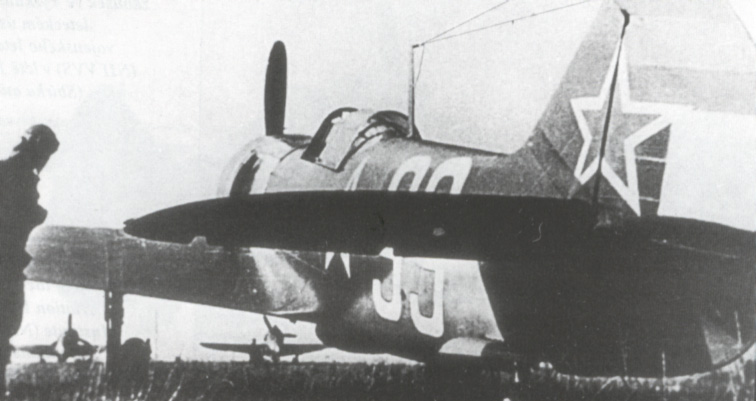
La-7s of the 176 GvIAP photographed during February, 1945. Whatever meaning these speculations may have for the actual appearance of "27" is unclear. We have only one, highly fractional, view of "White 27" during the period after this pause. This photograph dates from February 1945, and it shows us a small view of the nose of the aircraft. Typically published views look like this image.
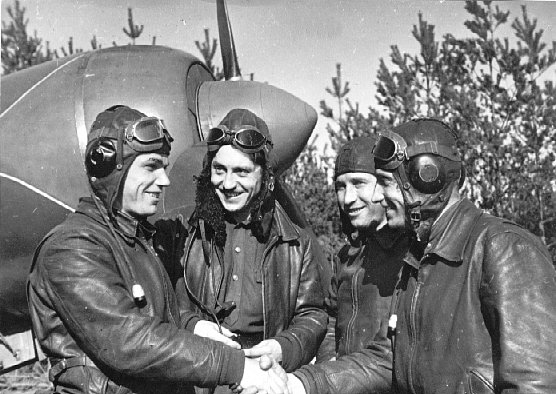
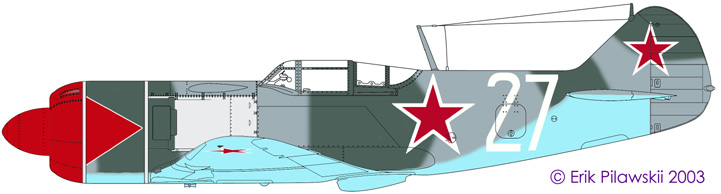
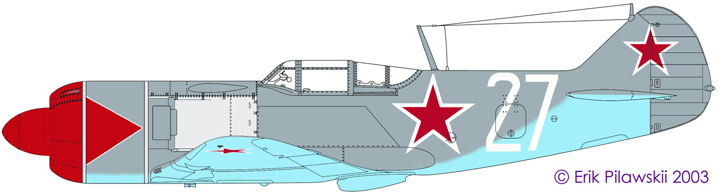
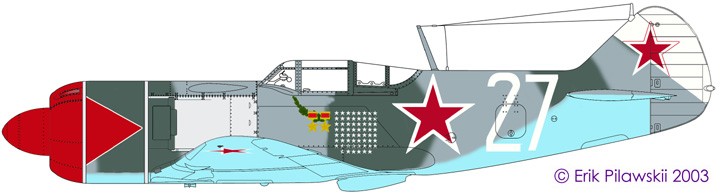
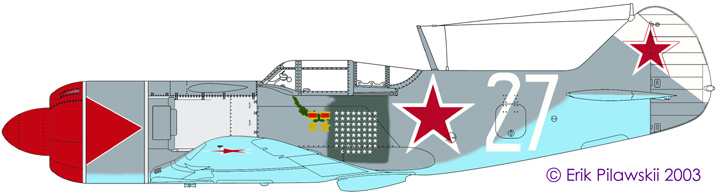
The original un-cropped photograph resides in the collection of the TsDAK. It is framed, and labeled "140 - Vikh" on the back of the frame (I do not understand what this reference means). This photo periodically hangs on the wall in the Hall of the GPW, where it can be seen publicly. The view in the original is not much wider, but it reinforces what we can 'tease' out of this view. We can clearly see the thin white trim that edges the red 'triangle' features on the aircraft's nose. The forward cowling, itself, is certainly red in colour, as is the spinner. The stainless steel cowl band is not painted. These details are in very fine agreement with the later appearance of "27" in the museum at TsDAK, minus the spinner's colour. This view also suggests that "White 27" must have sported these embellishments at least from this time (Feb/45), and one might speculate, then, probably from the time of this break in activity (Oct-Dec/44). Sadly, there is no view of the fin in this image, and thus no evidence as to the appearance of any trim there. Assuming a two-colour camouflage, "White 27" might have the following appearance during February 1945.
And as here if we assume a single-colour scheme.
Alas, and perhaps surprisingly, that is all of the factual information available on the wartime appearance of Kozhedub's aircraft. It seems quite remarkable indeed that this woefully inadequate description could be the progenitor of such a huge body of artistic and profile work! Recollections: Sergey Kramarenko In 1997 a series of interviews with S.M. Kramarenko were published in Czech magazine Aero Plastic Kit Review, starting it seems with issue no.64. The interviewer, S. Makarovich, asked Kramarenko specifically about service in the 176 GAIP, and Kozhedub's aircraft, which the latter claims to have piloted after Kozhedub left the Regiment. The following excerpts are from Kramarenko's answers, and were kindly provided and translated by Michal Sekula. "Sometime during preparation of the 'Carpathian-Visla' Operation (Nov-Dec 1944) the 176 GIAP received new La-7 fighter planes...." If this is so, then it is evidence in favour of the single-colour interpretation of "White 27". This testimony may explain just why so many 176 GIAP La-7s were finished in this way. " [Following a mission on 11 Feb/45 ] ...Kozedub’s plane was slightly damaged – two hits to the fuselage and one hit to the tail." If this damage were notable, could it explain some kind of repainting? Could it explain the repainting below the cockpit that might appear on the port fuselage (see below)? Could it suggest a reason for adding AMT-12 in a two-tone application? Kramarenko mentions further that he received Kozhedub's "White
27" after
the Deputy Commander was ordered to return to Moscow for the May Day
(1945) celebrations.
He states that he piloted this aircraft until the end of the War, and
that
it carried no "...small 'kill' stars nor three Hero of the Soviet Union
'Gold Medals' on the side....", which he asserts were painted later at
the Frunze Academy.
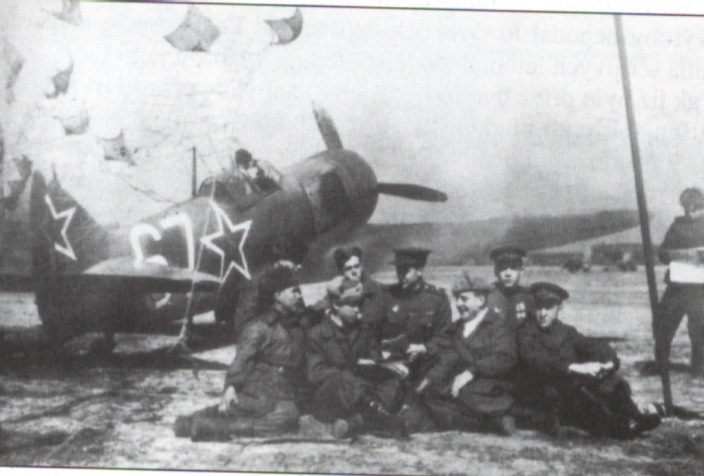
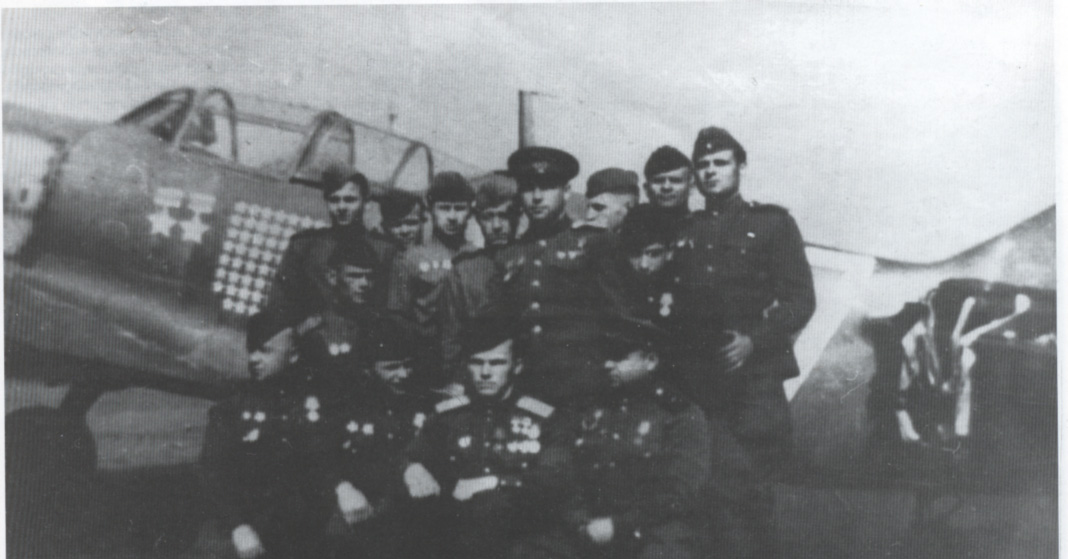
Victory and Embellishment During May 1945, "White 27"--like so many VVS aircraft after the War--was cleaned, polished, generally tarted up, and photographed. This is hardly surprising, given the successful conclusion to a most barbaric war; the pilots and soldiers of the Red Army must have been more than overjoyed and exuberant. This "parade" appearance (if one may use that term) of "White 27" is the subject of the photograph with which the modern reader is most familiar.
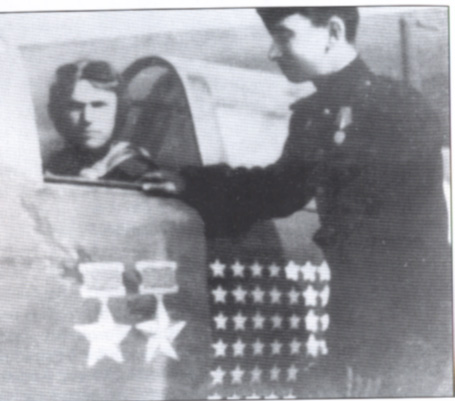
A close-up photo is also widely available of the cockpit area.
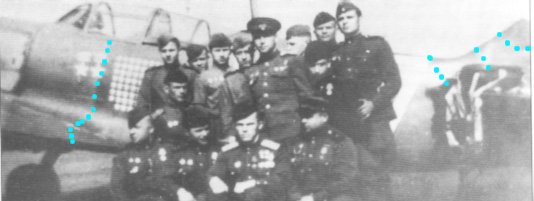
Many books have featured a version of this pictured printed in obverse (opposite); in fact, it does indeed show the port side, as the larger photo above. What, then, do we see in these images? On the port fuselage below the cockpit there is some obvious, rather attractive, and very freshly applied artwork. This looks to demonstrate a number of 'kill marking' stars, probably in white. How many is not known. It may be that there are 62 of them, but Kozhedub's officially recognized score was not agreed in May 1945 (not even until August 1945 in his nagodniy list' for the third Gold Star HSU). Two HSU badges are present ahead of these markings over a wreath, these with a very nice 3D star. The date of 'May 1945' for this photograph is not discounted by Kramarenko's testimony. Kozhedub spent only about 3 weeks in Moscow, and was back at the 176 GIAP in Germany by mid-May. He states himself in his memoirs that he was conducting a training flight at the unit on 17 May when he learned that his father had passed away. It would seem to be the case that "27" was decorated after Kozhedub returned to the unit and reclaimed his machine. The tactical numeral "27" was still in white, and featured no trim of any kind (as with its original appearance, no doubt). In the extreme upper right corner of the photograph there is just a hint of the fin/rudder flash that is so prominent on the Monino example photos [if this feature is not evident in this photograph version, I apologize for improperly cropping it]. As for the aircraft's colouration, many authors insist that this photograph demonstrates a two-colour scheme. Well, looking to the cockpit close-up, there is no doubt that a line of colour demarcation does run down the middle of the second HSU badge vertically. Is this appearance in agreement with the differences in tonal contrast between AMT-11 and AMT-12 lacquers on this film type? Yes, it is. However, does this area of colour contrast "prove" that "27" wore a two-colour camouflage? Obviously not. Looking to the wider photograph, proponents of a two-colour interpretation claim that colour demarcations can been in the locations marked on the following picture.
It is most prudent to note that the best one might offer here is that such an analysis, minus the clear colour demarcation on the fuselage side, is inconclusive. What is needed is a fresh examination of the original photographic negative. It would be helpful as well to generate new prints from this negative in the same process. Minus that kind of evidence, this view will offer nothing definitive on camouflage colouration. Returning our attention to the clear view of the cockpit area, here we might indeed see an area of AMT-12 paint. But, for what reason? Is this part of an NKAP Template camouflage application? Well, the placement of this demarcation is somewhat in line with these schemes, and this is possible. But, as well, virtually any explanation could be given for some paint in this location-- especially the conduct of minor repairs, which were required on 11 February. One interesting detail was pointed out only recently on a Russian language chat forum-- that no part of the canopy in this view appears to be coloured with AMT-12. This would make for a fairly unlikely factory camouflage scheme. The visible colour demarcation line is also not similar to the kind of semi-soft sprayed demarcation that we should expect to see on 1944 La-7 factory camouflage. Now, if this machine were Kozhedub's one and only La-7 fighter, then it would have been subject to the inspections of Oct-Nov/44. We should then expect to see the large areas of AMT-12 colour on the wing centre-section. Whether such a feature is present in this view is just not clear. Looking behind the pilot's heads, one does not see any obvious colour demarcations where clearly there should be some.
Does this inform us that the colouration is, in fact, an upper surface AMT-11 scheme as with so many 176 GIAP La-7s? If this lack of colour demarcation is truly a feature of this image, it seems to show that this area of AMT-12 colour is a square, in fact placed directly under the white 'kill' stars. Most interesting, if true. Or, is this observation a clue to a third possible interpretation: that "White 27" was originally a single-colour AMT-11 aircraft that was refinished with one of the typical (and messy) field-applied 'Template' schemes? These were so random in nature that virtually any pattern could be explained by them, no matter how unlikely. Looking to the above analysis, it seems that there are three primary possibilities: 1) That "White 27" was the original Kozhedub La-7 and was finished in AMT-11/-12. In this interpretation we have to assume that the photograph above is deceptive to a very large degree (not impossible with this kind of 'journalist' type film), and that the various applications of AMT-12 are not evident for this reason.
2) That "White 27" was delivered in a single-colour AMT-11 scheme, and remained in that colouration all of its life. This interpretation would assume that "27" was not Kozhedub's original La-7, and that it probably was manufactured and delivered during the pause in activities for the Regiment (Nov-Dec/44). This kind of delivery date is quite realistic for these newly manufactured machines; they were rushed to the front on an absolute priority basis (and surely the 176 GIAP would have been a priority!). Kramarenko's recollections seem to add weight to this view.
3) That "White 27" could have been finished in either manner, and that an indeterminate colouration resulted from the October/November inspections. In this case the interpretation would be that the areas of AMT-12 were either remnants of this work, or appliqué camouflage executed in the spring of 1945. The third interpretation would preclude, by default, any
colour profile
of "White 27". Since the details cannot be determined in the known
photographs,
and no attributable pattern can be associated with the camouflage,
there
is no way to render a drawing of the appearance of this aircraft. As
well,
there is no evidence whatever about the appearance of the starboard
side
fuselage; therefore, it seems inappropriate to assume that the various
kill markings and other artwork were present on this side at this time
(as in later appearances of "27").
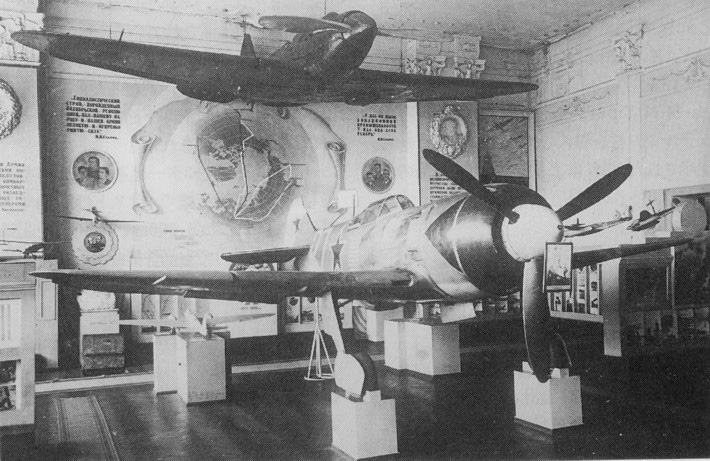
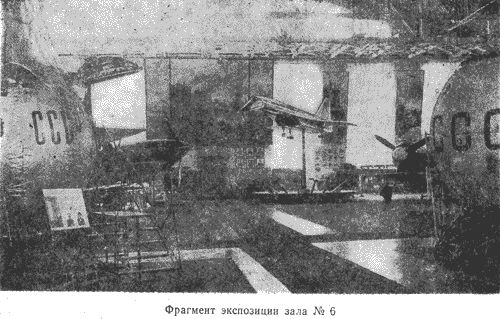
After the Victory-- TsAGI So, what then happened to Kozhedub's magnificent "White 27" after the War? To a point, this is--curiously-- the best documented part of this aircraft's life! Kozhedub retained "27" during his stay in Germany. In August he was recalled to Moscow for his third award of the Gold Star, Hero of the Soviet Union. It is thought (and so mentioned by himself) that he flew "27" to Moscow. Kozhedub remained in the capital for a considerable time following the award ceremony, and then was reassigned to other duties. His La-7, however, remained in Moscow. What happened to the aircraft then? During 1945 a number of very far-sighted Russians were placing historically significant machines into various displays across the USSR relating to the victory against Fascism. The Naval Museum in Leningrad, as well as the Defense of Leningrad Museum, were amongst the foremost proponents of this type of work, and the later GMA and Naval museums have their entire collections to thank for these fine efforts. In Moscow, this type of activity was taking place informally at TsAGI, at the LII, and at the TsDAK. Marshal Novikov, who commanded many illustrious aviation regiments, was known to be a vocal proponent of this idea. In 1947 Marshal Novikov formally inquired about the possibilities to permanently house important aircraft in various State collections. The request was made directly to Voroshilov, who agreed that such collections should be authorized. In effect, this decision codified the aircraft collections which were already in place in Leningrad and Moscow (primarily). None of the later OKB Museums (which now remain) were discussed at this time. After this discussion, the LII handed over all of the machines it had been keeping (for these purposes) to TsAGI. It seems that "White 27" also passed into the collection of the Zhukovskiy Institute (TsAGI) at this time, and was displayed informally for the students/staff at TsAGI. It is not clear if this aircraft had been in the custody of the VVS since 1945, but regardless it seems to have found a temporary home in 1947. Pravda mentions the existence of this aircraft at Zhukovskiy in a 1950 article, and so one can be pretty sure it was there during this general period. In 1955 "White 27" was displayed in public to celebrate the 10th anniversary of the Victory Against Fascist Germany. The aircraft was placed within a roped area in Red Square on what look to be red carpets, and a very attractive poster of Kozhedub was displayed next to the machine. Pravda printed a photograph of the aircraft in this condition in its 1955 Victory Day edition, and there is thought to be some 16mm movie film coverage of "27", as well (alas, this has not yet materialised). In this view, "27" looks to be finished in a single-colour AMT-11 scheme. The poster of Kozhedub, unfortunately, obscures most of the aircraft, but the white trim can be seen on the fin/rudder, and the numerals can be seen on the port side. After the Victory parade, it appears that "White 27" was placed into the collection of the TsDAK. A general transfer of aircraft from TsAGI seems to have been undertaken about this time, and certainly the Sopwith Triplane and Voisin bomber were transferred in 1954 (as documented in the TsDAK collection). As was the general rule of the time, these aircraft were not exhibited publicly as there were no facilities at TsDAK to accommodate them, and the collection really acted as a type of protected storage. The lack of specific mention in the TsDAK records about "White 27" should not be seen to be unusual at all, and the collection there appears to have been a bit informal (see below). In 1956 the VVS airfield at Monino was finally closed as a regular service operational air base. Hitherto, the airfield served mainly Il-4 bombers, and also a unit of Li-2 transports and the occasional Pe-2. Apparently the landing strip was deemed to be insufficiently long for jet aircraft requirements, and the so the operational history of Monino as a base came to a close. However, the VVS Academy was located at this facility, and it of course remained in operation. In 1956 the academy became the primary focus of Monino, as it remains today. At this time, Marshal Rudenko, Commander in Chief of the VVS, and Marshal Krasovskiy, Commander of the VVS Academy at Monino, developed an idea between them to make a museum of "technical and engineering interest" at Monino. This was seen to be the most suitable location for such a museum, and that it would be of great interest to the students of the academy. A number of ex- Il-4 repair hangars and workshops were ear-marked for this endeavour, and perhaps some limited work began in regards to their preparation for housing any subsequent facility. However, in 1958 the Central Committee of the Communist Party passed a resolution stating that "...all out-of-date aircraft, including both machines and engineering, must be dismantled and reused as scrap metal for the needs of contemporary production...." Alas, the Soviet Government at this time showed no more foresight that other Governments and Air Forces world-wide, and many irreplaceable historical aircraft were ignominiously scrapped as a result. This resolution, happily, was never applied to any of the existing museum collections, but all of the 'informally' preserved aircraft were of course in dire peril. Rudenko and Krasovskiy saw the danger at once, and reacted with speed. Work on the future museum at Monino began in earnest, and on 28 November 1958 Marshal Rudenko issued Order No.209: "To create a museum attached to the Monino Militarily Air Academy for the exhibition of aircraft engineering of the VVS. The museum-exhibition will show the development and battle application of indigenous Soviet aviation technique."The Museum of the Military Air Forces of the USSR was officially codified on that date under the direction of Maj. K.P. Danilin of the Academy. Danalin was assisted by a Deputy Director from the 'active' VVS in the form of Gen-Mai. M.V. Shishkin. Despite the odd discongruity of ranks, the two men worked well together at the Museum. The first aircraft in the Monino collection was in fact a DB-3 bomber which was reassembled from various parts in the very hangars which later housed the museum! These parts were left behind from the time of the airfield's service with Il-4s, and it is a very fitting historical addition to the collection. In 1960 the VVS Museum received a number of aircraft from various sources. From the Gromov Flight Institute a Yak-18 was obtained, and also some space/rockerty related memorabilia (about rockets in the VVS) from the Tsilokovskiy Institute. However, a large proportion of the new museum's collection came from the storage facilities of the TsDAK. Between 1958 and 1961 these included an La-11, La-15, Voisin, Farman, Sopwith Triplane, MiG-15, Il-10, Il-12, MiG-9, the famous ANT-2 "SSSR-1", and the most prized item of all, Kozhedub's La-7 "White 27". The majority of these aircraft were never listed in the collection at the TsDAK, and so it is not known how long they might have been kept there previously. The following photograph was taken in the same location as the mystery photograph above, and is usually captioned "1962 in Monino Hall No.1". However, this caption must be incorrect, because the location is certainly the Main Hall at the TsDAK. The Polikarpov TsKB-19 prototype can be seen hanging above, and this aircraft was never part of the Monino collection. The date is unknown, but might be from any time ca. 1955-61.
At this time, "White 27" appeared in a single-colour AMT-11 upper surface finish. The undersurfaces have the correct appearance on this photo (K-39 film was used here) for AMT-7, and there is every reason to believe that this was in fact the case. The details of the red 'triangle' features and the white trim are identical to the Feb/1945 photograph, and the location and nature of the upper/lower colour demarcation line on the lower cowling is also consistent with this view. As well, the national markings are of the more authentic white-border variety, and are notably not the stereotypical 'Victory' types, while the numerals remain un-trimmed. The spinner, however, is mysteriously painted white. The aircraft now sports the various HSU and 'kill' marking artwork on both the port and starboard sides. Hanging from the spinner, as well, is a framed version of the 1955 Pravda photograph of the machine at Red Square. Looking carefully at the spinner, the answer to this mystery (anyway) might be revealed. It seems to be a replacement unit from an La-5. The spinners of the La-5 (up to and including the -FN) have a Hucks starter collar on the tip. Spinners for the La-7 do not. This spinner has a starter collar attachment point; it is not an original La-7 spinner. This unit is clearly, therefore, a replacement--the white is colour is explained thus. There is, alas, no way to know when this change took place (the spinner can't be seen in the 1955 Pravda photo), but likely the original spinner was damaged during the aircraft's long years of storage and occasional display. Later (date unkown), this exhibit was revised. "White 27" remained on blocks as the centre-piece of the Hall, but more items were added around it (note the fuselage of a Bf 110 behind-- this was obtained from the LII). A walking platform was added to allow visitors to see into the cockpit.
The colouration and markings of "27" look to be completely unchanged. It seems extremely likely that "White 27" probably looked as follows during its stay (1955-61) at the TsDAK.
The author has spoken at length to many of the staff of the Monino Museum from this time. There is unanimous agreement that "27" was never retouched nor refinished by the staff after its delivery from the TsDAK. It is therefore exceedingly difficult to reconcile the Monino appearance of "27" with these images, which must have been taken shortly beofre the aircraft was handed over from TsDAK. It is most interesting that the aircraft, in its "1955-61"
appearance,
looks to match the available evidence of its wartime colouration extremely
well.
There is simply no evidence on this aircraft that
it was ever refinished.
The locations of the various painted items, like the tactical numerals,
nose trim, and even the camouflage colour demarcations are all
perfectly
identical to the 1945 photographs. Of special note here are the
national
star insignia, which had they been replaced would almost
certainly
have
been rendered with the thin red outline (the so-called 'Victory' style
star, which was the contemporary VVS insignia, as well). One can state
that the only omission in this record is a view from this time of the
port
side fuselage. Would we see the large square of AMT-12 colouration?
Were
all of the known photographs of "27" from this time taken from the
starboard
side deliberately for this reason (that such a blob of colour would be
regarded as 'ungainly')?
Mystery, Catastrophe or Conspiracy? The real mystery of "White 27" follows in what happened next. In 1965, the appearance of "27" changed, without explanation, permanently. There have always been rumours about the fate of Kozhedub's aircraft at Monino. Some of the mooted Conspiracy Theories are certainly far-fetched. However, the rumours of mishap are persistent, and credible. Many historians have examined the current La-7 specimen at Monino and found it to be unconvincing; this author certainly has been one of these. When the staff were pressed for answers a fair number of hushed rumours began to emerge with consistency. The most notable of these came from such persons as the former Director Yakovlevich, who recalled that there was some kind of "accident" involving "White 27" during the 1960s. They refused, in every case, to be specific or to say any more. Whatever happened? In 1965 there was some kind of "difficulty" with Hall No.1 at the museum. The museum's own records clearly show that this building was in a very sorry condition when it was allocated to the VVS Museum, and that it required constant repairs. No one at the museum questions this fact in any way. During 1965 Hall No.1 was suddenly closed to the public "for renovations". During the celebrations of the 20th Anniversary of the GPW victory, an La-7 aircraft went on display at Tushino. This aircraft was marked with "White 27", and it bore a sign stating that it was the aircraft of "Three-times HSU Kozhedub".
Suddenly, and inexplicably, "27" was now finished in an entirely new way. The aircraft was painted with what looks to be a solid coat on the upper surfaces of AMT-12 lacquer, including the stainless steel cowl bands and the plates aft of the exhausts. The star national markings from the fuselage sides were gone. The 'parade' markings were completely different, and drawn in different colours. The tactical numeral "27" were trimmed with a thin blue stripe, and the font style of the numbers had shifted slightly. A pair of utterly stupid and spurious national stars appeared on the wing upper surfaces. The star marking on the fin/rudder were much larger than seen previously. All of the facts lead to the inescapable conclusion that IF this machine was indeed "White 27", it had been completely and comprehensively refinished. The other possibility is that this aircraft was not the original "White 27", which begs the question of why it was labeled in this way? After the end of these celebrations in May 1965, Hall No.1 reopened at Monino. However, visitors would have been surprised to see that "White 27" was no longer located there. In fact, an La-7 bearing a perfect resemblance to the machine just displayed at Tushino was located in a back corner of Hall No.6, well out of the way of the public walkway. This machine was labeled only by a small A4 sized card stating that this was "Kozhedub's famous La-7". How on earth could "White 27" go from museum centre-piece to storage closet recluse, and so suddenly !?! To put what would arguably be amongst the five most priceless aviation artifacts in the world into this location seems beyond comprehension.
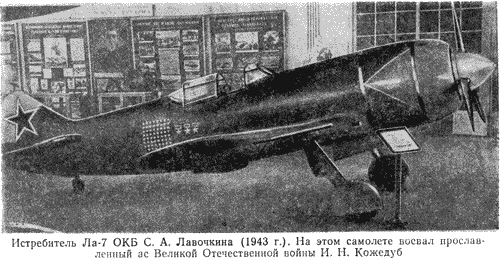
This photograph, from Monino's own visitor's brochure, is poor to say the least. What we can see in this picture, which certainly dates from the 1965-71 period, is that the spinner of "White 27" is white. Eyewitness accounts of the machine in this location state unanimously that it was finished exactly as the Tushino 1965 appearance, including the hideous upper wing surface star markings. Another curious view of "White 27" is available from Monino. This picture comes from a different VVS Museum brochure (which the author retrieved from the lobby of the Leningradskaya Hotel), and sadly there seems no obvious way to date it. This image, again poor, seems to throw the matter of this aircraft's colouration into even greater confusion.
This aircraft seems to be finished in what looks to be a single-colour finish of AMT-12. The various camouflage details such as the upper/lower colour demarcations, and so on, are not evident. The national marking on the fin/rudder seems to agree with the appearance of the same features on the 1965 Tushino "White 27". However, no numerals of any kind are present on the starboard fuselage, and the 'parade' artwork has been repainted in yet another style once again. The stainless steel cowl bands are exposed, which does not agree with the Tushino view, but the exhaust plates are painted (which does). Most intriguingly, however, we see a 'replacement' La-5 spinner, and this unit still has the Hucks starter collar attached! The current appearance of "White 27" was established in 1972 when the museum was expanded and reorganized into its current form (this is confirmed by eyewitness accounts of the exhibit at the 1972 re-opening). At this time, some 'Victory' type national stars were added to the aircraft, and the undersurface was 'touched up'. Here is a photograph which the author took in 1990.
Here is another (taken by others) from 2001.
Also at this time "27" was moved to Hall No.3, where it remains today. This is Hall is dedicated to the history of the GPW period, and therefore the location seems suitable for "White 27", despite the fact that many of the exhibits in this hall are, indeed, replicas. Looking closely at this specimen, one can see many problems. The cowling is heavily off-set, and crooked. The barrels of the (alleged) ShVAK are actually sticking out of the front of this unit. Absolutely no one is allowed to open or access the engine compartment, presumably to conceal the extreme difficulties that would be seen there. The cooling louvres are tightly shut, but peering in through the exhaust channel flaps one can see that much of the engine compartment is missing. There appears to be some kind of internal structure, and there are certainly no exhaust pipes exiting through these channels [however, recent photographs of the exhibit show some kind of engine inside the compartment]. One wonders if the ASh-82 motor sitting on the floor adjacent originally came from this machine? The aircraft in this view, mysteriously, has a proper La-7 type spinner, but painted in white colour. Where is "White 27s" La-5 replacement unit? The colouration looks indeed to be AMT-12 on the upper surfaces, but it is clearly AII Blue on the lower; how can one explain such a scheme? Why was this exhibit allegedly repainted in its entirety in 1965, anyway? Why were the original markings and colouration not replicated when it was? Why is the cockpit the only surviving La-7 specimen's in the world not to be finished in ALG-5 (as the Gor'ki and Moscow Production Diaries say it should), but rather in the pre-War method using A-14 lacquer? To regard this long (and, frankly, very incomplete) list of
problems
as merely "difficult" would be to demean the word through
understatement.
Conclusions What do we make of the long and complicated history of "White 27"? What conclusions regarding its appearance, if any, can be drawn? Regarding the wartime appearance of "White 27", there is no definitive answer. This researcher would suggest that the most likely answer, however, is still that the aircraft was finished in a single-colour AMT-11 camouflage. This interpretation, to my mind, matches the facts most closely, and requires the fewest unusual assumptions. In my own personal opinion, there seems to be no evidence--none--that "27" was repainted up to 1961 prior to being placed in the museum at Monino. This aircraft was in the care of TsAGI for most of its post-War life. We know from other examples that this organization was exceedingly professional and careful in the preservation of historic specimens. The Sopwith Triplane, for example, dates from the Russian Civil War and it is still in breathtakingly accurate and authentic condition. This surely was the fine work of TsAGI, who retained the aircraft for all of its early 'museum' life. It seems quite logical that such an important and valuable exhibit as "27" would have been maintained at Zhukovskiy in similar fashion. In the same vein, I suspect that the replacement spinner was most likely added while the machine was in the TsDAK collection's storage. It is therefore the most reasonable assumption, in my mind, that the appearance of "White 27" as photographed in 1955-61 is essentially the same appearance it had in May 1945. The only obvious change would the addition of the third HSU badge, and at this time possibly the execution of the 'parade' artwork on the starboard fuselage side. One considerable source of trouble for this kind of investigation is that there are no known views of "White 27" early in it's stay at Monino. The curious unknown views might date from this era, but there is no way to tell. The establishment of the aircraft's appearance during 1961-65 would be extremely helpful in understanding the course of events which followed that time. The current exhibit at Monino is undoubtedly the same aircraft that appeared at the Tushino display in 1965. The appearance and details are identical, and these are known (through photography) to have been essentially unchanged (with the modifications being progressive) since that time. The situation involving the cowling is mysterious; even the 1965 example seemed to be in mechanical order. It seems clear that some sort of mishap overtook this aircraft since 1965. The current "27" shows evidence of repainting in some locations, but always with the same AMT-12 finish. There is absolutely no evidence anywhere on this aircraft's upper surfaces that it has been painted with any lacquer other than AMT-12. I have personally examined some of the areas of this exhibit in detail, and I am certain beyond any doubt that, in these examined areas, this is so. Moreover, the wing upper surfaces do not demonstrate any signs of the usual primers (ALG-1 would be expected), indeed priming of any kind, nor the existence of filler putty. Such a condition is completely inexplicable. With the above analysis one matter is patently clear, and bit disturbing. It is simply not evident how one can reconcile the various known appearances of "White 27" with the current Monino exhibit "White 27". Since the current exhibit seems pretty clearly to have been painted with AMT-12 all of its life, how can this aircraft then be either an originally two-colour AMT-11/-12 camouflaged "White 27", or a single-colour AMT-11 camouflaged "White 27"? How do the various appearances of "27" make a coherent picture? What is the date of the unknown image of "27" with details of both the TsDAK version and the 1965 Tushino version? The first possibility is certainly the worst-- that a disaster struck the aircraft during, or prior to, 1965 and it was destroyed. It is worth noting that the TsKB-19, which was photographed hanging above "27", disappeared from the TsDAK collection and has never been seen again. The date of the building 'difficulties' which affected the Hall where "27" was stored at Monino also coincide with the new coluration of the exhibit. The appearance of the Tushino example could then be explained as a 'replacement' La-7, and therefore not the original Kozhedub aircraft. The second possibility is that the exhibit was comprehensively rebuilt at some time following a mishap. This might possibly explain some of the oddities with the current museum "27". This idea would pre-suppose a considerable amount of refinishing prior to this mishap. Moreover, it would require that this repainting work would have been of alternately superlative and inept quality. The third possibility is that "White 27" was deliberately refinished in a way that obscured the previous appearance(s). One can only guess at a motivation for such illogical behaviour, but it would be technically possible, and it might explain certain problems with the current exhibit. Perhaps another explanation can be found to reconcile these facts. Alas, I cannot think of what that may be at this time. What is crystal clear, however, is that help is needed desperately from the Russian Air Forces Museum at Monino. An exhibit of the La-7 fighter aircraft of Ivan N. Kozhedub is a historical treasure of unimaginable significance and value. Surely, with such serious and demonstrable concerns over the current and historical appearance of this specimen, the Museum must help all historians to ascertain the true and verifiable record of this exhibit. In brief, what is critically required at this time is:
Until such time, the current exhibit at Monino of "White 27" must appear to be incongruous with the evidence (such little as it is) we have of its historical finish and detail. I simply cannot see any way, or any theory, which explains these problems to any satisfactory degree. Well, save for one-- and that possibility is exceptionally ugly and disturbing, and I would prefer to hope that it is not true. I call on the outstanding staff at Monino, all professionals and dedicated to aviation matters and historical research, to re-examine "White 27" in the collection and help us understand these profound and potentially serious mysteries. Should
anyone have an additional
photographs of "White 27" in any condition, or any additional
information
on this matter, I would be deeply grateful to hear from you. Until such
time, the preceding work represents my own conclusions on the
disposition
of this aircraft according to the best currently known evidence.
|
| Single-Colour Finish | Two-Colour Finish |
 |
1944 |  |
 |
February 1945 |  |
 |
May 1945 |  |
 |
1955-61 | |