Frantic Scenes: VVS Aviation at Poltava in USAAF Cameras
Operation Frantic was
a series of seven shuttle-bombing raids conducted by the USAAF during
the war which utilised Soviet bases to enable a round trip attack on
distant German targets. Of additional interest is the record made of
the USAAF of these missions, and subsequently the capture of various
Soviet aircraft on American film types. Experienced photographic
interpreters will know that comparing images of subject matter on
different types and categories of film is exceedingly valuable in
achieving an understanding of the subject matter. By comparing the
resulting images with the known-- or sometimes suspected-- behaviour of
each respective type together, very significant progress can be made.
As a result, such images are a god-send, and well worth another look
here.
Poltava and "FRANTIC"
Operation FRANTIC was conducted during the period of June to
September, 1944. The USAAF's HQ and main facility was located at
Poltava airfield (Ukraine), where most of their photography was carried
out, but flights were made from nearby Mirgorod and Piryatin aerodromes
additionally. This time window of operations was fascinating from a VVS
point of view as it coincided with the introduction of several new
types (Yak-3, La-7, etc) into front-line service, with the increasingly
common appearance of the later style 'outline' type star national
marking (Victory Star) and with certain new concepts in factory
camouflage (single-colour applications made during the winter-spring of
1944). Could the American photography shed any light on these matters?
Moreover, the vast majority of our photographic evidence regarding
Soviet aviation comes-- quite obviously-- from Russian and German film
stock. The two are rather different in terms of chemistry and
behaviour, it is true, but alas German period photography is so
extensive and complex that no unified understanding of it exists at
this time. However, American photography of the period was often
excellent, and the properties of the various relevant film types are
exceedingly well known; in fact, historical film enthusiasts are still using these very emulsions to this day.
As a result, the various behaviours of these films are clearly
understood, and thus offer a superlative chance to compare their
behaviour against other types when investigating our subject matter.
So, with this chance to compare and contrast images of Soviet aviation
on yet another group of film types, what then does this record tell us?
Let us examine some specific cases.
Yak-9s
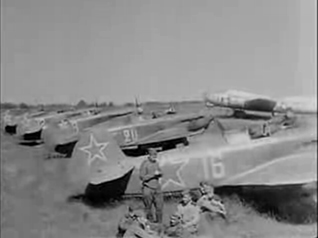
One of the classic images of operations at Poltava
is this a quality still taken from the USAAF film "Operation Frantic"
(1944). Due to the quality of the print, one presumes that thats still
was taken from the original 16 mm cine stock at that time (during
1944). The image shows some some Yak-9 fighters lined up near to a pair
of USAAF B-17Gs.
...And here, some captures from a Flash video version of the film, these necessarily of low quality:
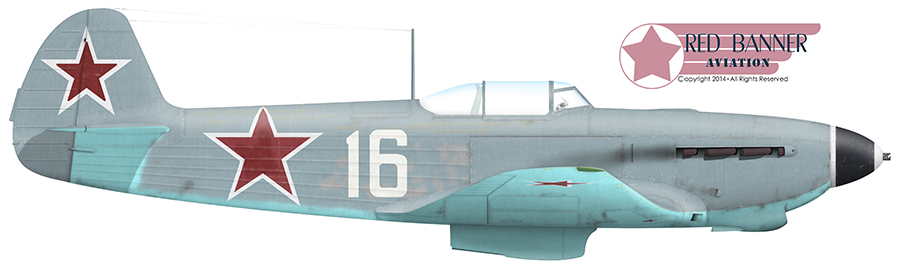
In the foreground we have the interesting specimen "White 16".
This aircraft is a typical Yak-9 model, but sporting what surely looks
to be a single-colour camouflage application in AMT-11 Grey-Blue of the
style which seems to have appeared at the turn of the year (Jan/44).
Yak-9s of this original type were still being manufactured at that
date, however, and so the finish could have
been factory applied.
However, the black spinner and the rather 'blotchy' appearance would
suggest that this machine was originally painted in AMT-4/-6 and
re-finished in the field. The national markings were of the
unremarkable white border variety (if
a bit large on the fuselage), and the tactical number applied in white
using a
likely font style. The spinner looks to have received some smart trim
both on the aft base of the unit and on the tip, and there is a
miniature red star on the undercarriage leg cover over the wheel.
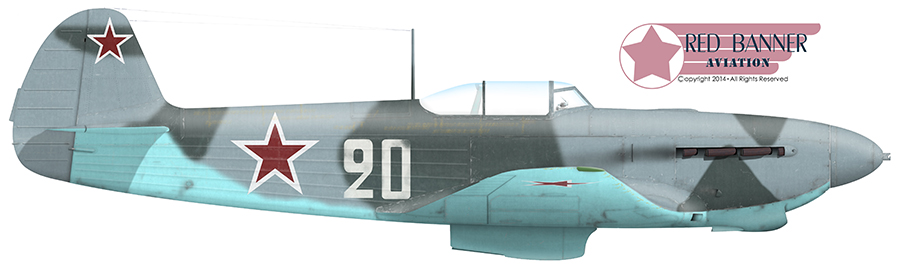
"White 20" is another Yak-9 model, but this time wearing the more usual
two-colour AMT-11/-12 camouflage in the NKAP pattern style. The
fuselage star is a typical white bordered unit, but the tactical
numeral features a 'closed' style '2' font of a type which I cannot
recall seeing on a VVS aircraft hitherto (it looks a bit like a German
aircraft of the First World War). [NB.
The relatively dark appearance of "20" next to "16" is partly an artefact of
image manipulation-- likely a level map adjustment-- but also this is a recognised behaviour of many period cine film
types in which objects behind the immediate focal plane appear darker
than those forward; examine the aftmost B-17 in comparison to the
foremost.] The spinner does not seem to have received any re-painting attention,
and the star marking on the fin is rather small.
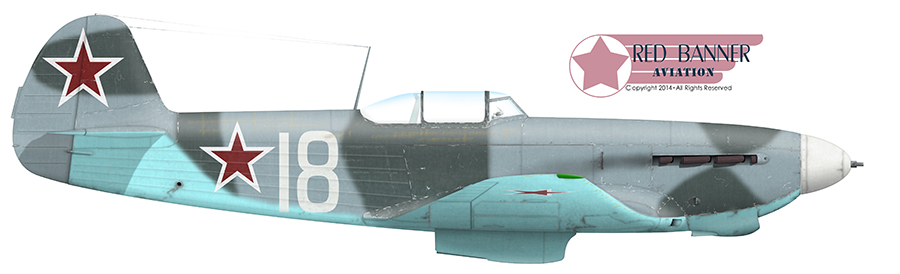
A Yak-9T can just be seen third in this line-up, and watching the
film clip it would appear to have the tactical numeral "18". A white
spinner is evident in this case, as is the expected and
usual NKAP style camouflage. The national makings are typical white
border types, and the numeral style is similar to (if larger) "16" in the
foreground.
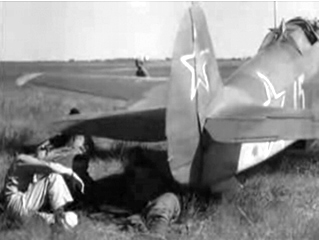
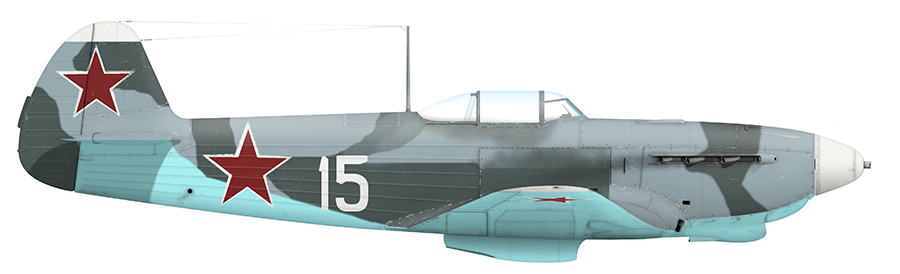
The last example in this line-up might be "White 15", shown to
right in
another 16 mm still. Following some more informed analysis we can identify "15" as a later series Yak-7B now in NKAP
colouration, albeit the scheme certainly looks to have been field
applied judging by its odd shapes and application. The national star
markings are heavily worn, especially so on the fin/rudder. A 'blob' of
AMT-12 lacquer
is visible on the port wing tip which is unusually large and
'straight', again
suggesting field rather than factory work (or a repair?).
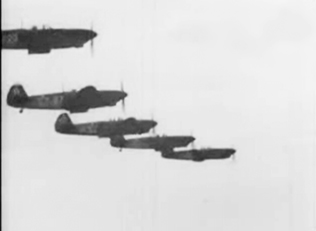
The final screen grab shows a mixture of Yak-7Bs and Yak-9s in flight.
The image is from the same film source as the others, and purports
to have been shot at Poltava. On balance, there is no reason to doubt
this assertion, and certainly this shows us a very common mixture of
Yak fighter types of the kind seen in the other line-up images, and
indeed known to have been stationed at this base. These examples would
seem to be wearing NKAP type camouflage and white border type stars, as
seen previously.
The Other Yaks
There is an exceedingly short bit of film in the original 1944 movie
(no more than 2-3 seconds), "Operation Frantic", which seems
incongruous with the other Yak fighters on display at Poltava. The following is a screen capture of this brief cut-over.
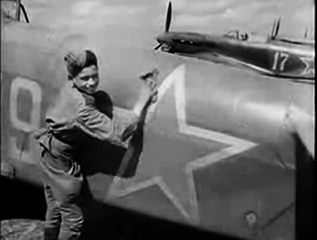
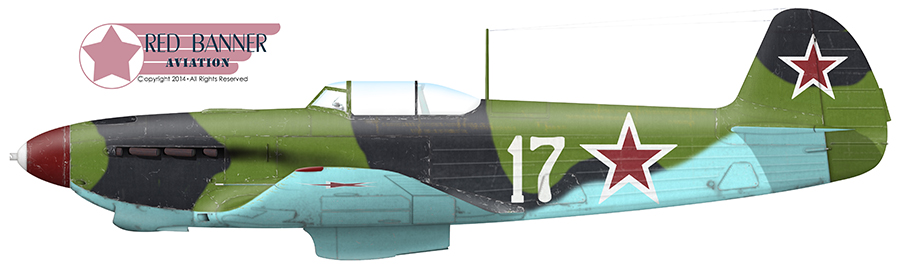
One presumes that the aircraft in foreground ("9"?) demonstrates the
usual NKAP Template AMT-11/-12/-7 colouration, albeit the tonal
variation in the image is exceptionally weak (poor exposure setting
during the shot). However, even if this is the case, what are we to
make of the machine behind? This is yet another Yak-9 model, in this
case with an apparently darker (being careful to recall cine film
behaviour) appearance, and a tactical numeral style not seen on any
other Yak in all of the various "Operation Frantic" coverage. Moreover,
the camouflage pattern visible around the cockpit is not similar to any
NKAP scheme, but rather resembles a known factory applied pattern from
Novosibirsk (as does the numeral font, as a matter of fact), which at
the time of manufacture was completed in AMT-4/-6/7. The Yak behind
this "White 17" looks to be similar.
Making no suppositions, the following profile is provided of "White 17"
with this earlier appearance. Equally, the case could be made that the
aircraft is, in fact, wearing a field applied -11/-12/-7 scheme with an
unusual pattern, which was certainly not an overly uncommon practice.
Lavochkin La-5F
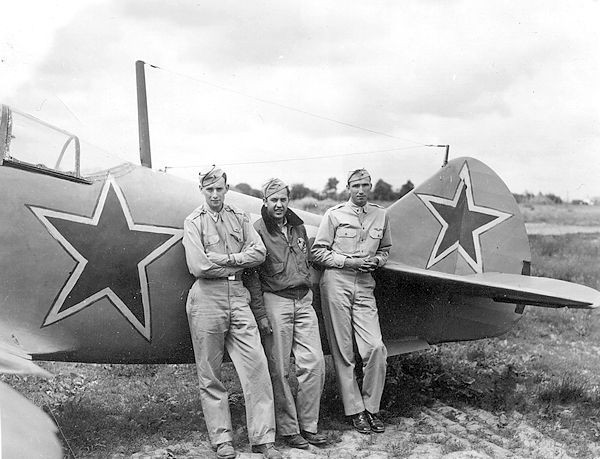
Here we see a very nicely turned out La-5F with a particularly
ametuerish national fuselage marking, giving a rather incongrouous appearance!
The caption suggests that this image was taken at Mirgorod; whether
this is indeed the case I do not know. However, we see here some 35 mm
Kodak film stock, the sharpness, clarity and characteristics of which
may be compared to the other 16 mm stills.
Of relative note is the sensitivity of the film to blue colours-- a
known characteristic-- giving an almost monochrome appearance. In fact,
the upper/lower colour demarcation can be picked out by manipulating
the image, and indeed this was executed in a very 'low' manner,
suggesting that the scheme was not a factory application.
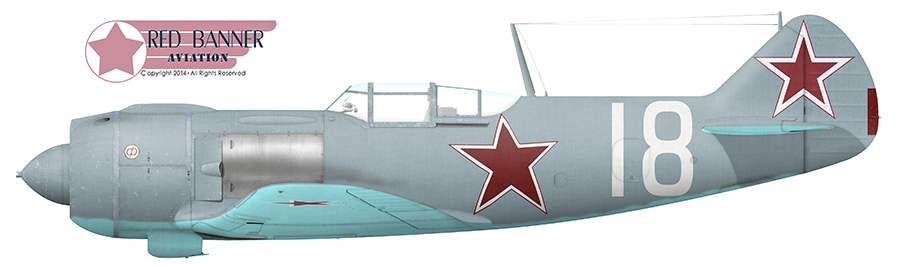
Interestingly, we see another single colour AMT-11 scheme (as with
"White 16"), but in this case the later style 'outline' or Victory type
national markings. The rudder trim tab has been painted in red, and it
would appear to be the case
that the tactical number is "18" (impossible to be certain). The nose
of the aircraft is not in view, and thus the following profile must be
regarded as reconstructive in this respect.
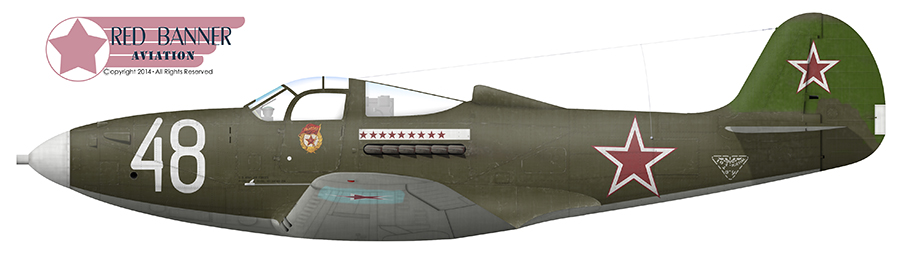
P-39 "White 48"
Sadly, this attractive Airacobra has had its serial number
obliterated, and so we cannot be sure whether this is an -N or -Q
model P-39. We can say for certain, however, that it has received the
aft fuselage strengthening modifications at the factory (suggesting a
-Q model), and not via the field work directed in the late summer
of 1944. The lack of obvious refinishing around the fuselage,
similarly, suggests that the aircraft was delivered in this condition,
and the very dark appearance is consistent with the later ANA paints
(613 O.D., for example).
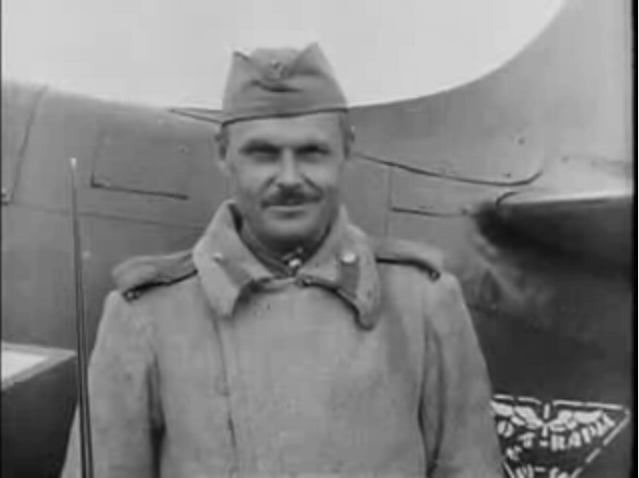
Of particular fascination is the small artwork device seen in the lower image (behind our rather dapper looking moustachio).
During many years spent examining images of Soviet aviation I do not
recall having seen the likes of this little crest, which appears to
incorporate the VVS' flight wings with some text. The exact text in
view is still unclear to my eyes-- is it "I A R D"? "K A R M"? Perhaps
some younger eyes will sort this out. In the meanwhile, the numbers to
left appear to end in '04', with another preceeding digit out of sight.
Since the machine surely belongs to a Guard's Regiment, could this
badge not denote the 104 GvIAP? The 104 (ex-298 IAP) was a strong
Airacobra regiment with exactly the right deployment to have been seen
in the Poltava area during August-September 1944.
Be that as it may, "White 48" demonstrates yet another example with
a painted rudder trim tab-- something of a fetish amongst the VVS, it
must be said. The fuselage star is in agreement with the usual Buffalo
plant placement, but has been amended to the Victory (outline) type
subsequently. The entire fin and rudder have been obliterated, here
showing A-24m lacquer (which seems to be the most likely choice), which
presumably was an example of the 'Anti-Yellow'
school of thought, and another star added. The small triangular device,
Guard's Badge and possibly the white spinner are likely related to the
unit (104 GvIAP?), while the pilot's own claims total (nine 'kills') is
apparent above the exhausts.
Conclusions
These images must, by their very nature, give us only the briefest and
most limited record of VVS operations in the Ukraine ca. 1944. However,
even so they represent valuable and relevant additions to our
understanding of this topic; more, it must be said, in confirmation
than in contradiction.
With regards to camouflage, that two examples of AMT-11 single-colour
colouration may be seen in such a small sample is interesting. It is
also notable that both were field applied, and no doubt this will spark
yet more debate on the origins of this scheme-- field vs factory--
and upon the longevity of this type of livery. Further, we may have
more evidence in view here for the occasional retention of the older
Green/Black colouration into 1944, something which has been noted
(especially on Yak fighters, it must be added) previously. If truly the
case, moreover, it would represent the latest date for such an
appearance known at this time.
All of the USAAF photography covering this episode, to include the 16
mm motion picture stock and the less frequently seen 35 mm films, agree
categorically with our other
sources of information regarding the wartime appearance of VVS colours.
To find comprehensive agreement between physical and chemical evidence,
and that offered up by Russian, German and now American photographic
evidence, must be recognised to be decisive. I simply cannot see where
those who maintain a different interpretation of the facts in this
matter can go next (except into fantasy, as seems to be their want).
Lastly, we have the appearance of a new type of aviation badge, or unit
device (at least, new to myself). This small, white triangular badge is
fascinating and unique. However, as with all things which appear on
official wartime camera, we must also ask (as historians) if this item
was a normal type device, or if indeed it had been applied specifically
so as to be photographed? A number of different aircrew and other
persons were filmed on and around this aircraft, so presumably it was
singled out for some reason and employed as a film prop. Is it this
fact which explains the badge, or was it present already?
Whatever the case there, I hope that readers will find this little
family of appearances to be an interesting example of operational
colouration during the summer of 1944 in the Ukraine. However small the
portrait, I always find such "family albums" to be endlessly intriguing.