
| The Aeroplanes That Never Were
|
Update 2020
Over the
years-- and most especially during times of war-- a number of
designations for various spurious aircraft have appeared, disappeared
and
reappeared, often in a manner defying logical understanding. How many
reports were issued regarding the "He 113", one wonders, for example?
Such has been the case, also, for the aircraft of the Soviet VVS as
reported by their adversaries and allies, alike. In this article we
will explore some of these cases, and try to understand from whence
such
terminologies developed, how they might have come into use, and to
which authentic aircraft these were likely to have referred.
The "I-17"
Perhaps the most widely misreported Russian aircraft of all, the
Polikarpov TsKB-15 and -19 designs were seemingly a source of near
hysterical obsession for many outside observers. I have lost track,
personally, of the number of well regarded reference books and other
sources which postulate the existence of this machine, issue claims for
the number in service, places for their alleged combat activities and
all manner of such type history. All of which, of course, is complete
nonsense: the TsKB-15 family did not enter production, and never (therefore,
and obviously) entered service with the VVS.
Precisely three examples
of this family were built, the first of which-- the TsKB-15-- was
completed in 1934. It is true that the type designation "I-17" was
indeed earmarked for this design, and GUAP did order Factory No 39 in
Moscow to prepare for manufacture of two TsKB-15s under that
designation on 28 February 1934. However, virtually all other technical
and government documentation on the type, to include an exceedingly
detailed and lengthy Teknicheskoe Opinsane (Technical Description), referred to the design as the TsKB-15,
and never as the "I-17". In fact, the exact terminology used in the
GUAP instructions related to the "I-17 Project", which likely explains
why the subsequent TsKB-19 revision of the prototype was also an
"I-17". Ultimately, a third example was completed (by 1936) with the
M-100 motor as the TsKB-19bis, and this was similarly part of the I-17
Project.

|

|

|
The TsKB-15
|
The TsKB-19
|
The TsKB-19bis
|
The Soviet government-- or perhaps Nikolai Polikarpov, himself-- may
have popularised the designation "I-17" to some degree. Following the
TsKB-19's over flight of Red Square during the 1936 May Day parade, V.
Chkalov issued his famous automotive quip involving the aircraft, "The
I-17 against the I-16 may be compared as the Lincoln against the Ford."
TsAGI Test Pilot Popov's evaluation of his flight in the TsKB-19 is
titled thusly, but in the written portion of the report he employs the
term "I-17" almost exclusively. And, in the same period, Chief Designer
Tomashevich, who was a member of the Central Design Bureau (TsKB) and
considerably involved with the aircraft, used the terms "I-17" and even
"I-17bis" in his correspondence with the NKAP. Even if not the
aircraft's official
designation (whatever we may mean by that), the term "I-17" certainly
was understood to refer to the TsKB-19 (at least) in aviation circles.
Subsequently, the designation "I-17" may have come into use in Western
aviation literature following the 1936 Paris Air Salon, during which
the TsKB-19 was on prominent display. The only photo of the aircraft's display
from Le Bourget which I have seen shows "TsKB-19" painted on the tail,
but it is not impossible that perhaps some further signage or labels
were presented alongside this exhibit. With its daring, futuristic
shape and French Hispano-Suiza engine, one might understand that the
aircraft drew considerable interest in Paris.
Additional obfuscation no doubt ensued when the Government proposed a
virtually bewildering number of sub-projects and developments of the
I-17 Project family. In no particular order, GUAP/NKAP instructions for
such permutations during the period 1935-38 included the following
variants:
To have been designated "I-18"
·TsKB-33
·TsKB-43
To have been designated "I-19"
·TsKB-25 (Gnome-Rhone)
·TsKB-25 (M-34)
·TsKB-25 (HS-12Y and revised armament)
To have been designated "I-20"
·TsKB-28
To have been designated "I-21"
·TsKB-19bis (M-34FRN)
Being quite similar in appearance, externally, anyone would
be forgiven for confusing these proposals with the I-17 (TsKB-19), even
within the Soviet aviation community.
Lastly, there is some evidence that the government employed the I-17 in
a modest propaganda role. Images exist showing the TsKB-19 and the
-19bis sitting together, both painted in some type of exceedingly shiny finish, and additionally wearing VVS style national markings and tactical numbers.
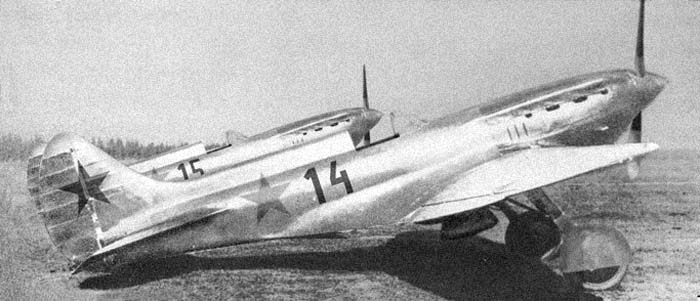
Whatever the truth of these various observations, the result of such
was that the "I-17" came to be an accepted type in VVS service so far
as the outside world was concerned. Many USA intelligence reports, such
as FM30-34 (which,
see) listed the type, and even gave specific totals of machines in
service. Finnish victory claims from the Winter War are replete with
references to successes against the "I-17" (which are rather telling,
as there were no in-line engined fighters of any kind in VVS service
during that campaign). Luftwaffe pilots were similarly "successful"
against the "I-17", and also the "I-18", and such claims may be found
in German records into 1943.
From these accounts the type "I-17" became a mainstay in Western
literature on Soviet aviation of the 1930s and 40s. It featured in most
such works of the latter 20th century, and only gradually disappeared
from circulation following the millennium, displaced by the increasing
research and authorship which has evolved since since that time. Even
so, colour profiles of "service" I-17s may still be found across the
internet and in various books on the topic. The long arms of confusion
and ignorance on VVS matters reach far, indeed.
The "MiG-5"
One of the most confusing aspects of Soviet aviation during the 1930s and 40s was
the bewildering number of prototypes which were designated "DIS".
During 1941, alone, for example, the government ordered prototypes
named "DIS" (dvukhmotorniy istrebitel soporovozhdenya-- or, twin-engined escort fighter) from Kocherigin, Mikoyan-Gurevich (which was re-designated the DIS-200) and Polikarpov (which was re-designated the DIT). Of these, the MiG OKB DIS-200 enjoyed the greatest development.
The original DIS-200 was powered by the Mikulin AM-37 motor, and on 1
March 1941 the government reserved the nomenclature "MiG-5" for this
aircraft, hoping to launch manufacture at Factory No 1. Replacing the
un-ready AM-37s with serviceable M-105A engines did not save the design,
which suffered from poor handling and flight behaviour and was rejected
by the NII VVS. The MiG Bureau later attempted to resurrect the type by
fitting two powerful M-82 radials, but this permutation of the DIS-200
(sometimes re-branded as the IT) failed on the same grounds, and
production was never instigated.
However, the designation "MiG-5" was widely reported in German military
documentation of the time, and especially so on pilot victory claim
lists, where it might be seen throughout 1942. Since the DIS-200 was
never the recipient of outside publicity, to which aircraft could they
have been referring?
It is quite possible that the Germans came to believe that the suffix
"-5" in Soviet aircraft designations referred to the use of the M-82
radial in the design. The 'La-5' was an 'LaGG-3' with an M-82 radial
(indeed, this was literally true
of early examples), after all, and one does see the occasional reference to the "Jak-5" (Yak-7 M-82?); did they hear of a 'MiG-5
with M-82 engines', perhaps? In any event, it seems clear that German pilots
were in fact referring to the MiG-3 M-82 prototype, which-- with the
greatest possible irony-- nearly went into manufacture at Kuibishev as
the "MiG-9"! MiG-9 was not used by German forces, but MiG-5 was, and I am sure that the MiG-3 M-82 is what they had in mind.
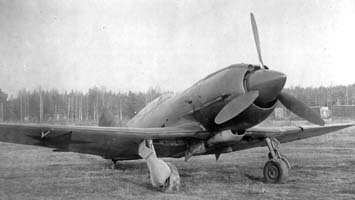
Of course, the MiG-3 M-82 (I-210) did not enter production and the
designation
"MiG-9", as well as "MiG-5", remained unused [NB. At least until the
advent of the I-300 jet fighter, after the war, which became the
production MiG-9]. Whichever design the Germans did ultimately assume to be
the "MiG-5", such did not exist in any case.
The "MiG-7"
The term "MiG-7" has been widely employed over the years to refer to
any one of a number of quite similar Mikoyan-Gurevich aircraft of the
I-200 prototype family. Similarly to the I-17, the "MiG-7" was much
mooted in Western literature during the latter half of the 20th
century, with development and unit / deployment histories appearing in
numerous books and articles. Alas-- and also in similarity to the
"I-17"-- all such ideas were spurious and no such production aircraft,
or designation, ever came into use.
It is quite possible that many observers were fooled by the copious
number of I-200 family machines, all of which bore more than a passing
similarity, and merged these in to a single type. In that case, perhaps
the sight of so many different appearances suggested a service
employment of the aircraft, and indeed the designation "MiG-7" had,
after all, been planned for this aircraft... or, no?
In fact, the designation "MiG-7" had originally been reserved for a
version of the MiG-3 powered by the AM-37 motor during 1941. By the end
of the year this proposal had become merged with a confusing
proliferation of MiG-3 development schemes, among which included the
I-230 (D), the I-231 (AM-39) and the I-211 (E) with an M-82 radial, to
name only the main proposals.
During March 1942 the GKO decided to clarify these projects, and at the
same time scrapped the AM-37 engined MiG-3 version for a new design with the same motor-- the I-220 (A). Here is surely where the confusion set in: a MiG development with the AM-37 became a MiG development with the AM-37... classic stuff for ambiguity. For the new prototype, the I-220, the designation "MiG-11" was reserved.
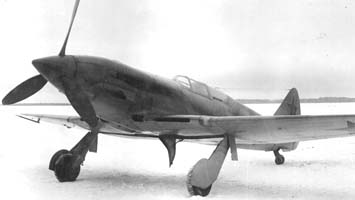
The I-220, or "MiG-11", for years misconstrued as the "MiG-7"
The I-220, which the MiG OKB referred to merely as the Type "A",
remained in development for almost two years. It was powered in turn by
the AM-38F, then the AM-39, and lastly by the AM-42B. No production was
undertaken. From the I-220 sprang a number of developments, the major
versions being the I-221 (2A), the I-222 (3A), the I-224 (4A) and the
I-225 (5A). None of these prototypes went into production nor service,
as neither did the AM-37 version of the MiG-3; there was, ultimately,
no "MiG-7" nor "MiG-11" nor any aircraft of a similar nomenclature.
The "LaGG-1"
The wide spread us of the designation "LaGG-1" was not so much a case
of mistaken identity, but rather of incomplete developmental history.
Soviet government documents refer to the original I-301 prototype in
three ways, seemingly without prejudice: I-301, LaGG I-301 and LaGG-1.
It is certainly true that the NKAP had intended to issue the
designation "LaGG-1", but in the event modifications were required to
the I-301 in preparations for series manufacture. These changes were of
a sufficiently significant nature that by the time mass production
began, the I-301 was re-christened the LaGG-3 (likely to differentiate from the early configuration).
No "LaGG-1" aircraft were built, and the type never existed. Despite
that, references to this aircraft are commonplace, and the term may be
found throughout German records of the period, not to mention in more
modern books and other works. All of these references are, one must
say, in error.
The "I-16 Type 6"
The I-16 "Type 6" has been an absolute mainstay in most literature on
the Polikarpov fighter over the years, often enough even within Russian aviation
work. However, somewhat predictably-- since the type did not exist--
the exact model to which all of these descriptions has been applied
vary greatly. Blame in this case is actually attributable to, of all persons, V.B. Shavrov. In his excellent tome on Soviet aviation [The History of Aircraft Construction in the USSR] it is Shavrov, himself, who posits the designation "Type 6" as referring to a Type 5 model powered by the M-25A motor. This is a mistake-- all Type 5s were powered by the M-25A.
The designation "Type 6" has a very long history in Spanish literature on the Civil War, even as early as the 1950s. In the main this problem arose from Shavrov's work, but as well the case has been put forward of such a reference from a single manifest taken from the SS Cabo San Augustin,
where the hand-written term "Type 6" can be found [NB. having seen a
copy, myself, I do not think that the cipher was a '6 in any case, just
a badly formed '5']. If this is indeed true it is a very strange thing,
as the same manifest contains dozens of typed references to the correct nomenclature Type 5;
why on earth would anyone accept an indistinct blob of handwriting in
preference to those? However, I think that the sheer longevity of this misconception was not just Savrov, nor any manifest, but rather the usual Western
desperation to insist upon different version and variant names for
aircraft (since that is what Western manufacturers do). When, for
example, such authors could not find any suffixes to explain the
various Il-2 permutations to be seen in photographs, they simply made
them up ("...ah, yes, this one is a two seater-- must be an '-M'
model..!"); the same for Yaks, for T-34 tanks, and host of other Red
Army equipment.
In other Western literature the designation "Type 6" has evolved over
the years. Initially, the name was often applied to ski-equipped Type
5s, particularly those seen in the Russo-Finish Winter War.
Subsequently, "Type 6" suggested a change in engine (a la Shavrov), usually from the M-25A to the M-25V (which in fact powered
the Type 10). Latterly, the "Type 6" was identified as the 1938 model
Type 5, which featured a windscreen replacing the sliding hood.
Finally, senior Russian historian Mikhail Maslov (in 1998) suggested that perhaps the designation "Type 6" might have applied to the 30 I-16 Ispanskii models
built at Gor'ki. In the end, this turned out not to be so. The Ispanskii models were actually four-gun Type 5 aircraft, and served as a de facto prototype of the Type 10 which went into series production directly after the former were shipped to Spain.
In every case, these designations "Type 6" are erroneous. No such model
existed and the nomenclature was not used. All I-16 Type 5 permutations
remained Type 5, and nothing else.
The "SB-1", "SB-2" and "SB-3"
Mistaken or misinterpreted Soviet aircraft designations were-- and are still--
certainly common enough. Witness, for example, the host of spurious
designations attached to the Ilyushin Il-2 ("Il-2M", "-M3", and
who-knows-what else...), for example. But, for some reason the family
of Tupolev ANT-40 medium bombers have been especially confused, and
indeed it is difficult to understand why.
One might presume that the widely used term "SB-2" is no more than a confusion of the correct, and full, type nomenclature of SB 2-M100.
But, if this is so, then from whence the terms "SB-1" and "SB-3"? There
was obviously neither a single nor three-engined SB version, so how
would those numbers become included in such a similar mistake (e.g. SB
3-M100)? The latter SB was powered by the M-103, of course, but that is rather a transposition of ciphers as compared to the previous error, is it not?
However, even at the time there was ample evidence available so that any outsider or foreign intelligence service should have
been able to understand the aircraft's correct designation. The Spanish
Republicans, when not employing their preferred nick-name of "Katiuska",
reported the machine accurately as "Tupolev SB" in many documents.
Similarly, the Czechoslovaks acquired a production license and built
their own version as the Avia B.71, correctly identifying this as an SB
variant. Examples of the SB were captured in Spain by the Fascists, and
these were described by them, and later inspected by foreign
governments. How, in the light of such evidence on the topic, could
these designations have come about remains a mystery.
Whatever the origin of these designations, all of them were incorrect
and did not exist. That they would have persisted so doggedly to this
day is yet another sign of the strides in popularising the VVS and its
aircraft which still need to be made.
Prototypes Identified as Service Machines
Luftwaffe combat reports and claims lists often feature the names of legitimate Soviet aircraft in their contents which were prototypes,
and not machines in service nor combat action. During 1941 and '42 the
"I-180" was often mentioned, and many claims were made for "successes"
against this adversary. The I-180 was indeed a Polikarpov OKB
prototype, but it certainly did not enter production (and obviously
not, thus, combat). It is difficult to imagine which machines the
German pilots had in mind with these claims.
Another curious entry is for a host of claims against the "I-21". In
this case the designation was assigned more than once, most notably in
the first case for a varient of the TsKB-19 (see above), then latterly
it was reserved for Pashinin's 1941 prototype (with the M-105P engine),
amongst others. The "I-28" was yet another common such entry, and here
one suspects that Senior Designer Yatsenko's I-28 was the mooted
aircraft. Ultimately, none of these machines reached production, let
alone combat service.

|

|
 |
The I-180 no 2 prototype
|
Pashinin's I-21
|
Yatsenko's I-28
|
---------------------------
