|
The Most Colourful Yak-1b of HSU V.P. Pokrovskiy Problems in Analysing and Interpreting Period Images |
Vladimir Pavlovich Pokrovskiy was an exceedingly experienced Naval (VMF) ace of the Great Patriotic War. Serving throughout with the Northern Fleet's (VMF-SF) 72 SAP-- later to renamed the 2 Guards IAP-- Pokrovskiy was a contemporary of the illustrious Boris Safonov, fighting the majority of his battles during the bitterly difficult first two years of war.
During his combat service, Pokrovskiy piloted a host of different types, including more than one I-153, several I-16s, an unknown number of Hurricanes, at least two P-40E Kittyhawks, a P-40M, and for a short while a P-39N. At last, during the summer of 1944, Pokrovskiy received a Yak-1b, and it is to this machine-- which he quite obviously cherished-- that we will turn our attentions.
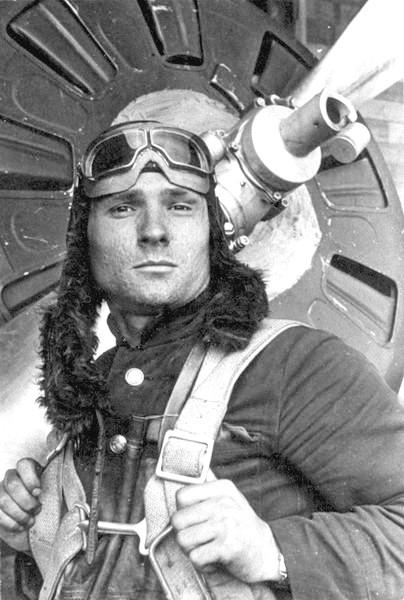
Pokrovskiy striking an heroic figure in front of an M-63 engined I-16 during 1941-42.
The Photograph
To reconstruct the appearance of Pokrovskiy's Yak-1, we must obviously start with a review of the evidence at hand. In this case, we have available a period photograph of Pokrovskiy's aircraft. The shot was taken under difficult lighting conditions, was over-exposed, and quite likely the glass plate negative (it looks to be the usual K- series film) was not processed in the most fortuitous manner. Common to many such period photographs of Russian origin, the resulting image is poor.

Perhaps more frustratingly, the scene is also 'cropped' so far as the various details of the paintwork are concerned. The entire nose of the machine is not in view, rendering any subsequent reconstruction of this area mere speculation. Another person is standing alongside the aeroplane, blocking some of the decorative artwork. Moreover, the rudder is clipped in this image, and some of the details of the 'kill stars' located there are thus lost (more of this below).
The appearance of the aircraft gives some clues as to the timing of the photo. The presence of 'Victory' type national insignia (thin red outline stars) is consistent with any time during which the regiment operated the Yak-1 (from summer 1944), but increasingly likely as the date moves into 1945. The camouflage would appear to be a single-colour AMT-11 upper surface application, and this would not be expected prior to the late autumn of 1944 (possible, of course, but unusual indeed), and more so during 1945 yet again. The number of 'kill stars' on the fin / rudder appear to number 21, which would be consistent with Pokrovskiy's own claims during the late 1944 - early 1945 period (1).
Problems of Interpretation
Despite the obvious difficulties inherent in the image, and its relatively poor quality, it must also be said that many of the profile drawings (or other artwork) completed for this aircraft hitherto have not been very satisfactory. Careful attention is required in such cases to tease out the finer details of the appearance, and yet many such profiles would seem to have been completed in a very lackadaisical manner. Many, as well, look to have been completed by artists who are rather unfamiliar with VVS subject matter, or who have received poor or incomplete guidance and advice from the authors for whom their work was created. The results, therefore, have been... well... predictable.
For example, I could not find any other profile completed hitherto which depicts the 'line' (chording, ribbon, orientation marks?) features which accompany the three upper rows of 'kill stars'. These markings are invariably applied incorrectly, and in most cases there are by far too few of them, with many drawings omitting entire rows of stars altogether. Despite the image being cropped at this point, it seems clear to me that there were five stars on each row, extending a bit onto the rudder (the tip of one being just visible), and six on the lowest, curved row, giving 21 in total.
The relative proportionality of the fuselage artwork has often been quite inconsistent with regards to the aircraft's size, or to that of the national markings. Some artwork even depict the small artefact defacing the image (small white rectangle, possibly present on the print, but more likely on the negative) as part of the aircraft's appearance! Other details are equally errant. The national insignia are invariably rendered as perfect, symmetrical stars of regular and uniform proportions. In fact, the actual markings on this machine are neither of those things, having been applied by hand, and are quite oddly formed and lacking in orientation as well as execution. As a result, the corresponding shapes of the surrounding details on such drawings fail by definition and present an unconvincing likeness. A clear lack of familiarity with VVS subject matter accompanies much of this work, with all manner of spurious, inaccurate and curious detail features replete within many of the drawings. A particular failure to be able to distinguish between different variants of Yakovlev fighters is most prominent.
Ideas of Colour
After all of the technical details are sorted and rendered for any drawing of this aircraft, the matter of the appearance of the various colours in view must be taken in hand. A wealth of differing interpretations exist for these various colours, which is fair enough given that the actual such shades in view cannot be proven by the examination of this image. However, it seems to me that there are more and less likely colours to presume here, and that a greater or lesser amount of complexity in regards to the execution of the finish can be supposed.
It is always possible that the aircraft in view has been repainted with the utmost effort and expenditure of time and materials, but in most cases this scenario will not have been the reality. The daily demands of both military flight and Army service do not often allow for such largess, and as well one must consider what sorts of paints would be on hand at the regiment based just south of Murmansk, and which personnel might have been on hand to execute the artwork. In none of these cases can we be certain, and so logical supposition must replace historical exactitude.
If we presume that the aircraft was painted in the most simplistic manner which can be explained by this image-- the method requiring the least over-all effort and expenditure-- then I believe that the appearance would match the following profile.
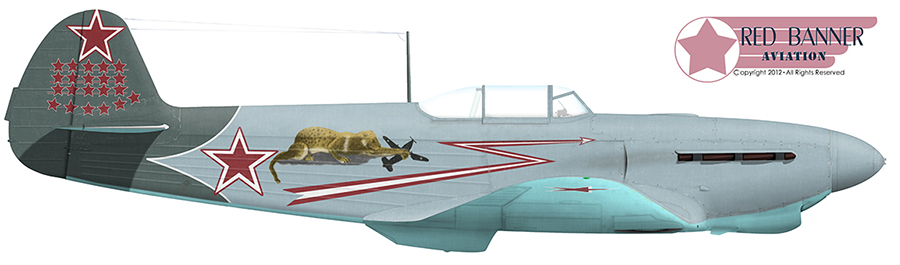
The basic camouflage in view seems certainly to comprise AMT-11
over AMT-7; fair enough. The most straightforward method to arrive at
this appearance, then, would be to assume that the dark tail area is
none other than AMT-12 Dark Grey lacquer, as would have been applied in
any normal 1944-45 two-colour scheme. Such paint would have been
ubiquitous and available. The trim comprising the colour border, and
also along the stabiliser leading edge, is most simply explained as
white paint, this slightly darker than that of the star markings via a
less stringent application. The lower colour (AMT-7) demarcation line
would have remained, and the 'kill stars' on the fin / rudder would be trimmed
also in white. No information exists regarding the appearance of the
spinner, so the simplest assumption is to leave it without decoration.
Considerable artistic talent was applied to create the lion cub (?) artwork and the lighting bolt features. These may, or may not, have been completed at the same time as the other painting, and the affect of such timing as regards the complexity of the latter work is interesting to ponder. Should all of the work have fallen into the hands of a more artistically inclined individual, shall we say, then the possibility might increase that such work was also executed to a higher standard of complexity.
In that case, the next most likely explanation of the appearance of the scheme would seem to me to look like this drawing.

The trim colour (demarcation and 'kill star' border) is still
white, but the rear fuselage painting now extends over the entire aft
section of the airframe, including the lower surfaces. With such
increased decoration, might the spinner have received such treatment?
Red coloured spinners appear in many profiles of this machine, but the
photographic record shows that most aircraft of the 2 GvIAP-SF which
sport a painted spinner have one in white colour. The justification for a red choice is unclear; I am aware of no anecdotal evidence for such.
However, if we suppose that the same artist who created such a lovely 'lion cub' drawing also painted the rest of this aeroplane, would such a talent restrict themselves to mere white trim? Obviously this person might have had a full palette of colours at hand, and in that case did they apply such artistry to the colour choices for the borders and outlines? Several other drawings have presented the trim colours as yellow in hue, based upon the slight difference in tone between these areas and the white of the star markings, and such is possible. A few Yaks-- usually Yak-3s it must be admitted-- from 1945 demonstrate exceedingly complex trim colouration, these often featuring gold-yellow trim (red and gold, after all, being the national USSR flag colours). Could Pokrovskiy's Yak-1 has sought to match these examples?
In this very complex case, the aircraft might have resembled the following drawing.
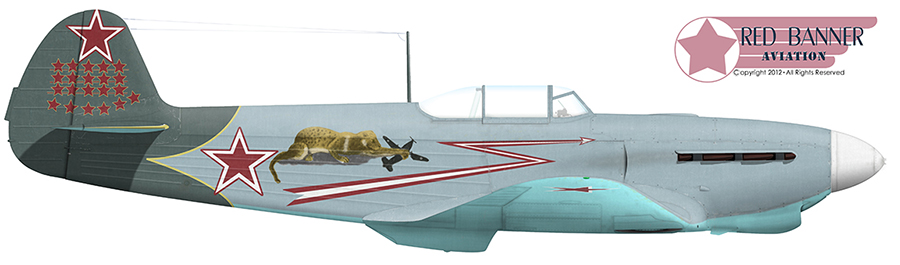
The appearance here is quite striking, indeed, and one rather hopes that the original specimen did look like this! Alas, we cannot know if this might have been so with any degree of confidence.
Now, one further colour matter must be considered-- was the rear fuselage painted with AMT-12, in fact? It is unquestionably the case that AMT-12 colour would agree perfectly in tone with what we see on this image. However, such is not a guarantee that this paint was employed on the aft fuselage, so if not AMT-12, what other plausible possibilities can explain the appearance on this photo?
Two further colour interpretations seem to dominate the largest body of work regarding this aircraft. One the one hand, the rear fuselage colour has been suggested to be a red paint, this likely being a local mix (not the usual AII Red lacquer) and thus slightly lighter in hue than the red found on the national star markings (and bolt feature, it would seem). The application of locally sourced red paint to wartime VVS aircraft is certainly known, and thus such a suggestion does represent a possibility. In such a case, the resulting scheme might look like this profile.
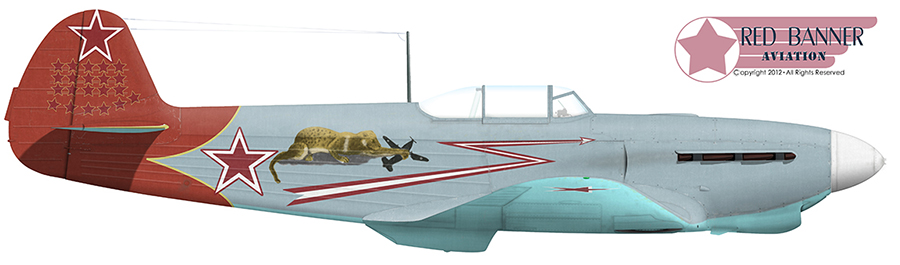
One must assume, here, that the painter would have chosen to employ
such a local red finish deliberately so as to obtain the 'artistic'
colour contrast with the darker red 'kill stars' and such like.
Although admittedly pleasing, this modest contrast of colours would not
have been visible from any significant distance, reducing its visual
utility as a decoration.
A last suggestion which seems to be in vogue is to suppose a blue painted aft fuselage. Due to the tonal properties of the image, one might be able to suggest a sizeable number of different blue hues which could be explained by the appearance of the machine in the photo, and so choosing from amongst these would represent a very considerable range of personal preference. To my mind, if the colour would indeed have been a type of blue, this should agree with a fundamentally common and available aviation use lacquer. Therefore, in the following drawing this possibility is represented by A-10 Blue primer.
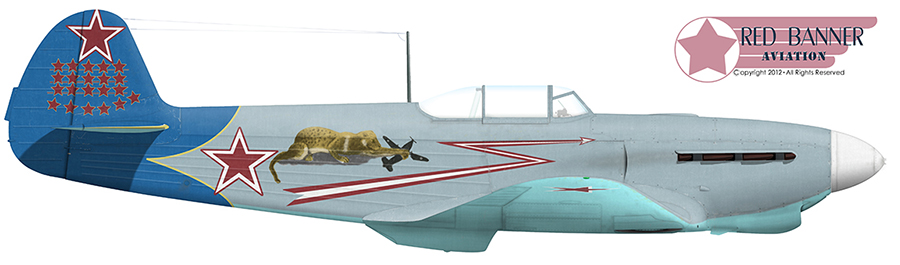
It cannot be denied that such an appearance would have been stunning; but likely...?
And So...?
In the end we simply cannot know how this Yak-1 looked in historical fact. Sufficient evidence on this point simply does not exist.
That said, the likelihood of any given interpretation might be described with greater confidence. Surely, under field conditions, the more simplified application would be the more plausible. As well, the interpretation requiring the fewest assumptions will always be the more likely. That is not to say the more accurate-- simply superior in probability.
With my Historian hat on, I must argue that the least complex suggestion is the one which might best circulate with regards to the usual discussion of the appearance of this aircraft. That is to say, the first profile (above) with an AMT-12 aft section and basic white trim. This interpretation of the appearance requires the fewest assumptions and presents the simplest procedure for having completed the scheme. It must be the most likely of these options.
However, with my enthusiast hat on, I rather prefer the more complex interpretations to the simple. The gold-yellow trimmed specimens are spectacular, regardless of the rear fuselage colour, and thoroughly delightful on the eye. Without doubt, Pokrovskiy must have cherished this Yak, and obviously lavished his time and attention upon it. To what extent, we wonder, would he have been prepared to insist on the complexity and artistic merit of its final appearance?
Perhaps one day we will know for sure.
1. Pokrovskiy's own recollection during the war amounted to 13 Personal and 12 Shared victories. Whatever the truth of these figures, the official Naval total for V.P. Pokrovskiy is given as 12 Personal and 6 Shared confirmed claims.
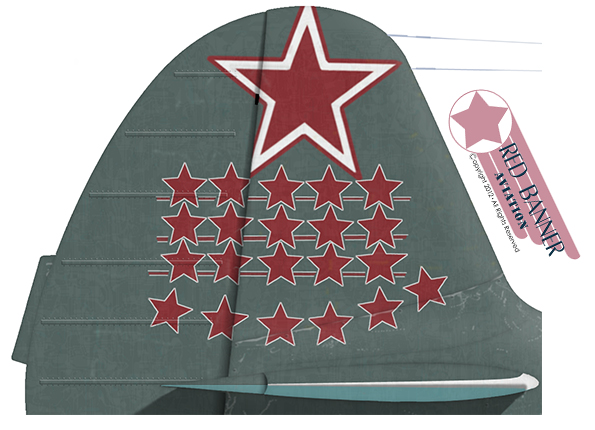
Enlarged view of the fin and rudder showing the various 'kill stars'.
To reconstruct the appearance of Pokrovskiy's Yak-1, we must obviously start with a review of the evidence at hand. In this case, we have available a period photograph of Pokrovskiy's aircraft. The shot was taken under difficult lighting conditions, was over-exposed, and quite likely the glass plate negative (it looks to be the usual K- series film) was not processed in the most fortuitous manner. Common to many such period photographs of Russian origin, the resulting image is poor.
Perhaps more frustratingly, the scene is also 'cropped' so far as the various details of the paintwork are concerned. The entire nose of the machine is not in view, rendering any subsequent reconstruction of this area mere speculation. Another person is standing alongside the aeroplane, blocking some of the decorative artwork. Moreover, the rudder is clipped in this image, and some of the details of the 'kill stars' located there are thus lost (more of this below).
The appearance of the aircraft gives some clues as to the timing of the photo. The presence of 'Victory' type national insignia (thin red outline stars) is consistent with any time during which the regiment operated the Yak-1 (from summer 1944), but increasingly likely as the date moves into 1945. The camouflage would appear to be a single-colour AMT-11 upper surface application, and this would not be expected prior to the late autumn of 1944 (possible, of course, but unusual indeed), and more so during 1945 yet again. The number of 'kill stars' on the fin / rudder appear to number 21, which would be consistent with Pokrovskiy's own claims during the late 1944 - early 1945 period (1).
Problems of Interpretation
Despite the obvious difficulties inherent in the image, and its relatively poor quality, it must also be said that many of the profile drawings (or other artwork) completed for this aircraft hitherto have not been very satisfactory. Careful attention is required in such cases to tease out the finer details of the appearance, and yet many such profiles would seem to have been completed in a very lackadaisical manner. Many, as well, look to have been completed by artists who are rather unfamiliar with VVS subject matter, or who have received poor or incomplete guidance and advice from the authors for whom their work was created. The results, therefore, have been... well... predictable.
For example, I could not find any other profile completed hitherto which depicts the 'line' (chording, ribbon, orientation marks?) features which accompany the three upper rows of 'kill stars'. These markings are invariably applied incorrectly, and in most cases there are by far too few of them, with many drawings omitting entire rows of stars altogether. Despite the image being cropped at this point, it seems clear to me that there were five stars on each row, extending a bit onto the rudder (the tip of one being just visible), and six on the lowest, curved row, giving 21 in total.
The relative proportionality of the fuselage artwork has often been quite inconsistent with regards to the aircraft's size, or to that of the national markings. Some artwork even depict the small artefact defacing the image (small white rectangle, possibly present on the print, but more likely on the negative) as part of the aircraft's appearance! Other details are equally errant. The national insignia are invariably rendered as perfect, symmetrical stars of regular and uniform proportions. In fact, the actual markings on this machine are neither of those things, having been applied by hand, and are quite oddly formed and lacking in orientation as well as execution. As a result, the corresponding shapes of the surrounding details on such drawings fail by definition and present an unconvincing likeness. A clear lack of familiarity with VVS subject matter accompanies much of this work, with all manner of spurious, inaccurate and curious detail features replete within many of the drawings. A particular failure to be able to distinguish between different variants of Yakovlev fighters is most prominent.
Ideas of Colour
After all of the technical details are sorted and rendered for any drawing of this aircraft, the matter of the appearance of the various colours in view must be taken in hand. A wealth of differing interpretations exist for these various colours, which is fair enough given that the actual such shades in view cannot be proven by the examination of this image. However, it seems to me that there are more and less likely colours to presume here, and that a greater or lesser amount of complexity in regards to the execution of the finish can be supposed.
It is always possible that the aircraft in view has been repainted with the utmost effort and expenditure of time and materials, but in most cases this scenario will not have been the reality. The daily demands of both military flight and Army service do not often allow for such largess, and as well one must consider what sorts of paints would be on hand at the regiment based just south of Murmansk, and which personnel might have been on hand to execute the artwork. In none of these cases can we be certain, and so logical supposition must replace historical exactitude.
If we presume that the aircraft was painted in the most simplistic manner which can be explained by this image-- the method requiring the least over-all effort and expenditure-- then I believe that the appearance would match the following profile.
Considerable artistic talent was applied to create the lion cub (?) artwork and the lighting bolt features. These may, or may not, have been completed at the same time as the other painting, and the affect of such timing as regards the complexity of the latter work is interesting to ponder. Should all of the work have fallen into the hands of a more artistically inclined individual, shall we say, then the possibility might increase that such work was also executed to a higher standard of complexity.
In that case, the next most likely explanation of the appearance of the scheme would seem to me to look like this drawing.
However, if we suppose that the same artist who created such a lovely 'lion cub' drawing also painted the rest of this aeroplane, would such a talent restrict themselves to mere white trim? Obviously this person might have had a full palette of colours at hand, and in that case did they apply such artistry to the colour choices for the borders and outlines? Several other drawings have presented the trim colours as yellow in hue, based upon the slight difference in tone between these areas and the white of the star markings, and such is possible. A few Yaks-- usually Yak-3s it must be admitted-- from 1945 demonstrate exceedingly complex trim colouration, these often featuring gold-yellow trim (red and gold, after all, being the national USSR flag colours). Could Pokrovskiy's Yak-1 has sought to match these examples?
In this very complex case, the aircraft might have resembled the following drawing.
Now, one further colour matter must be considered-- was the rear fuselage painted with AMT-12, in fact? It is unquestionably the case that AMT-12 colour would agree perfectly in tone with what we see on this image. However, such is not a guarantee that this paint was employed on the aft fuselage, so if not AMT-12, what other plausible possibilities can explain the appearance on this photo?
Two further colour interpretations seem to dominate the largest body of work regarding this aircraft. One the one hand, the rear fuselage colour has been suggested to be a red paint, this likely being a local mix (not the usual AII Red lacquer) and thus slightly lighter in hue than the red found on the national star markings (and bolt feature, it would seem). The application of locally sourced red paint to wartime VVS aircraft is certainly known, and thus such a suggestion does represent a possibility. In such a case, the resulting scheme might look like this profile.
A last suggestion which seems to be in vogue is to suppose a blue painted aft fuselage. Due to the tonal properties of the image, one might be able to suggest a sizeable number of different blue hues which could be explained by the appearance of the machine in the photo, and so choosing from amongst these would represent a very considerable range of personal preference. To my mind, if the colour would indeed have been a type of blue, this should agree with a fundamentally common and available aviation use lacquer. Therefore, in the following drawing this possibility is represented by A-10 Blue primer.
And So...?
In the end we simply cannot know how this Yak-1 looked in historical fact. Sufficient evidence on this point simply does not exist.
That said, the likelihood of any given interpretation might be described with greater confidence. Surely, under field conditions, the more simplified application would be the more plausible. As well, the interpretation requiring the fewest assumptions will always be the more likely. That is not to say the more accurate-- simply superior in probability.
With my Historian hat on, I must argue that the least complex suggestion is the one which might best circulate with regards to the usual discussion of the appearance of this aircraft. That is to say, the first profile (above) with an AMT-12 aft section and basic white trim. This interpretation of the appearance requires the fewest assumptions and presents the simplest procedure for having completed the scheme. It must be the most likely of these options.
However, with my enthusiast hat on, I rather prefer the more complex interpretations to the simple. The gold-yellow trimmed specimens are spectacular, regardless of the rear fuselage colour, and thoroughly delightful on the eye. Without doubt, Pokrovskiy must have cherished this Yak, and obviously lavished his time and attention upon it. To what extent, we wonder, would he have been prepared to insist on the complexity and artistic merit of its final appearance?
Perhaps one day we will know for sure.
. . . . . .
1. Pokrovskiy's own recollection during the war amounted to 13 Personal and 12 Shared victories. Whatever the truth of these figures, the official Naval total for V.P. Pokrovskiy is given as 12 Personal and 6 Shared confirmed claims.
Enlarged view of the fin and rudder showing the various 'kill stars'.