| The 1943 NKAP Templates Explained |
Students of VVS camouflage will encounter references to this Ministry in regards to various camouflage schemes and other matters of colouration with which they may not be entirely familiar. As a result, this article will attempt to clarify the NAKP's contribution to, and guidance of, the camouflage of VVS aircraft during the wartime period. The NKAP was responsible during the Great Patriotic War for making recommendations and policies pertaining to-- amongst a myriad other things-- the painting of military aircraft. Likewise, when new aero lacquers were introduced, it was at the behest of this Ministry, and under their guidance. Thus it came to be that during the War a number of suggested camouflage schemes were mooted by the NKAP.
These suggested schemes, in fact, were just that-- they were recommendations. These were not requirements in any sense of the word, neither was their use enforced by the Government, although it is fair to say that they were promoted heavily by the NKAP, and often. The specific patterns suggested by the NKAP were issued in the form of a three-view 'template' showing the desired application, and thus they have come to be known as the "NKAP Templates".
Fighter Aviation
|
|
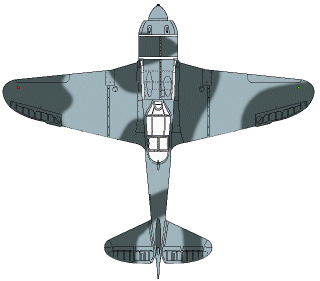
An NKAP Template was issued in 1943 for VVS fighter aircraft [see also Basic VVS Camouflage]. This Template accompanied the introduction into manufacture of several new aero lacquer colors, these all of the "AMT" variety of aviation finishes. The new color scheme suggested for fighter aviation consisted of a two-color disruptive application of AMT-12 Dark Grey over AMT-11 Grey-Blue. The Template was intended to apply to all VVS fighters, regardless of type.
Certainly after the beginning of 1944, the use of the new grey colours as stipulated by the NKAP become universal at factories manufacturing VVS fighters, and these same paints were applied with equal vigour to existing aircraft serving in the field. The conversion of the VVS fighter force to grey colouration was comprehensive.
However, there are no photographs which
show any VVS fighter wearing such an angular pattern application as
depicted in the Template. Indeed, such a rigid scheme was anathema to
Soviet camouflage in
general, which tended to be organic and rounded in execution; such
angularity would be completely out of character. As such, the NKAP
fighter template
was never painted by any of the factories to match the official
diagram.
However, that said, the basic planform of the scheme was put into use; indeed, widespread use. These applications are usually referred to as 'NKAP schemes', and they are composed of many of the basic features on this Template. Grib's famous Yak-9D "White 22" is a classic example of an actual VVS scheme based on the NKAP fighter Template, and in the realities of production the 'NKAP Template' patterns tended to look like these examples.
|
|
|
|
The classic 'hourglass' feature (above, left) on the starboard nose is evident, as is a softer and simplified permutation of the upper surface pattern shapes. Hard-edged color demarcations were almost never seen in the 1944-45 period (a la the Template).
In the Yak-3 programme (above, centre), the 'tongue' feature of dark color on the starboard fin was quite typical, as were off-set 'hourglass' features. The La-7 (above, right) often demonstrated a considerably revised upper surface pattern, but more typical side views.
In all, it should be stressed that there was no real "standard" for these patterns. Simply, many factories responded by incorporating some of the NKAP's ideas into the schemes they applied to their fighter products, but by no means whatever were these the only camouflage patterns of the 1944-45 period in AMT-12/-11/-7 colors.
The Shturmovik
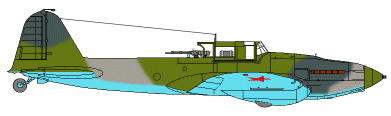
No fewer than three Templates were issued for Il-2 camouflage by the NKAP during the GPW. Two of these appeared in 1943, and the last in late 1944. The 1943 Templates were both 3-colour camouflage schemes using the finishes AMT-4, AMT-12, and AMT-1 (over AMT-7 unders). The 1944 Template, curiously, employed a two-colour AMT-12/-11 camouflage very similar to the Fighter Template 1943 scheme, but so far as is known in both the written and photographic record, this option was completely ignored by the various factories building the aircraft.
The scale of the employment of these NKAP camouflage schemes, and using the specified AMT colours, is a matter not yet resolved satisfactorily. It is simply not known in what proportion these 3-colour applications were made with respect to the previous, and still popular, two-colour AII scheme of Brown/Green. There are examples of these NKAP Template schemes on surviving specimens of both straight-winged--and more typically--on swept-wing (arrow) two-seat Il-2s, but none as yet on single-seat machines, as one would certainly suspect (given the timing of the NKAP recommendations). It should be noted also that this scheme can be difficult to detect on the poorer Soviet film types (basically, journalist type films), and so the total number of representative examples might possibly be higher that the proportion suspected today. Lastly, to further confuse matters, there is good evidence available suggesting that Il-2s were finished with the older AII lacquers according to the NKAP Template pattern (as was done on the Pe-2).
|
|
|
|
|
|
|
|
 |
 |
 |
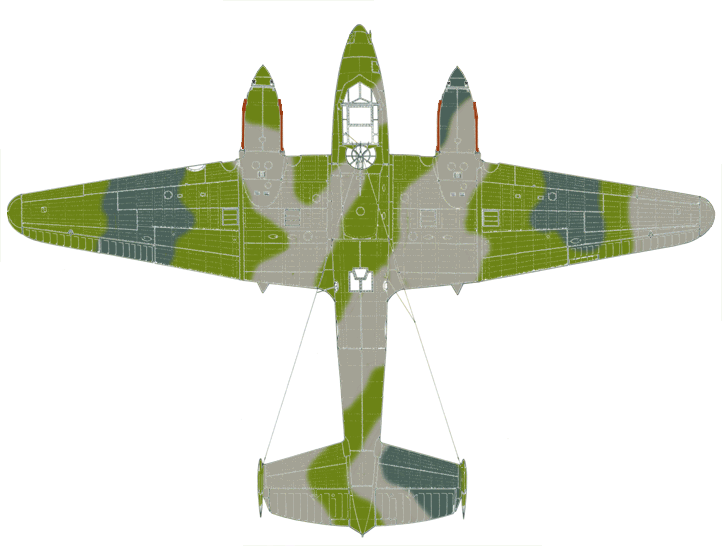
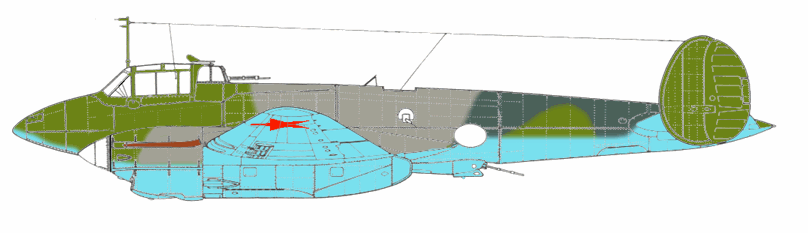
This pattern was much more in line with the other NKAP template work, and represented a much better scheme from the point of view of the factories. This application is certainly known on numerous Pe-2s, and seems to have been in use right through 1945 (and well after). It is also interesting to note that this same pattern might have been executed with AII lacquers (probably Green, Light Brown, and Brown), as well. Additionally, several permutations of this "theme" are known in AII colours on the Pe-2, and one has to speculate that this template again was the source of inspiration for these patterns.
The appearance of the Pe-2 in Ax-m metal lacquers is most interesting, as well. These colours are all quite dark, and the resulting contrast within the scheme is very low indeed. This effect is all the more pronounced in black-and-white photography [one can replicate this phenomenon to a degree by viewing the image below in greyscale], where the colours are often completely indistinguishable. It is very likely that this observation explains the reason why we see so many late-war Pe-2s drawn in various colour artwork in a single-colour "green" scheme. In fact, one can be sure that most of these examples are very probably Ax-m lacquer camouflage applications.

The Variant #2 template was thought to have been used on the Tu-2 programme heavily, as well, and certainly there are many examples of this aircraft that seem to be wearing versions of this scheme. Additional research concerning the development and implementation of colouration on the Tu-2 programme is currently under way.
The U-2/Po-2
The venerable kurkurznik ('corn-stalk
cutter') was not exempt from the design intentions of the NKAP during the Great
Patriotic War. During 1943 an NKAP template was issued for this extraordinarily
useful machine, and was intended for application to the military versions of the aircraft,
only. The template lists the AMT colours -4/-12/-1 again, and but really offers
little else in elaboration.
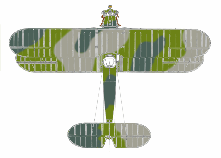
The resulting use of the NKAP Template scheme on the Po-2 was likely to have been modest. For many decades examples of such a scheme were unknown, but just in the last couple of years a few photographs have surfaced showing Po-2s in a 3-colour NKAP type pattern. Should one also assume that these aircraft were painted with AMT lacquers?
AII aviation aero lacquers were developed during the 1930's specifically to cover fabric surfaces (and were used similarly after the GPW). Indeed, this is precisely why the NKAP recommended the use of AII Aluminium as a primer for all fabric surfaces (this technique was widely used during the period). Noting that the U-2 is entirely fabric covered, it seems altogether possible that AMT lacquers would not have been first choice for use by the factories making the workman-like biplane because these would have given inferior results to AII. The quite staggering number of curious, remarkable and astounding patterns and schemes seen on the Po-2 in AII type paints are testament to this notion. Indeed, with the same rationale in mind, it is possible to speculate that NKAP type schemes would have appeared in AII type finishes, as well. All of which is not to say that AMT lacquers were unlikely to have been used, but the suspicion has got to persist that they were modestly so, and vastly in the minority compared to AII.